

 中文简体
中文简体 Español
 русский
 Deutsch
 Français
Content
How Cleanroom Wipes Remove Surface Contaminants
Cleanroom wipes remove surface contaminants through a combination of mechanical disruption and capillary entrapment. When a wipe contacts a surface, the physical wiping action overcomes the adhesion forces that bind particles to the substrate. Studies demonstrate that a modest downward force of approximately 0.5 kg on a cleanroom wipe translates into roughly 50 kg of force at the microscopic contact points where individual fibers interact with the surface, effectively dislodging particles as small as 0.1 µm.
The primary binding force between particles and surfaces is capillary force, which can be three times greater than Van der Waals forces for 1 µm particles in humid environments. Wetted wipes apply low surface tension fluids—such as isopropyl alcohol (IPA)—that reduce this capillary adhesion, allowing particles to release more easily. Once dislodged, the wipe's fiber structure traps contaminants through hydroscopic capillary forces, creating an "overpowering bias" that prevents particles from resettling on the surface.
The Four Forces of Particle Adhesion
Contaminants adhere to cleanroom surfaces through four distinct physical forces. Understanding these mechanisms explains why wiping is superior to passive cleaning methods:
- Gravity – Causes larger, more massive particles to settle on horizontal surfaces like floors and workstations.
- Van der Waals Forces – Molecular attractions at the atomic level that create strong bonds between particles and surfaces, particularly in dry environments.
- Electrostatic Charges – Opposite charges between particles and surfaces cause clinging similar to static electricity, a significant concern in electronics manufacturing.
- Capillary (Hydroscopic) Forces – Moisture bridges between particles and surfaces that increase adhesion; in humid controlled environments, these are often the strongest forces.
Wet Wiping vs. Dry Wiping Performance
Research consistently shows that damp or pre-saturated wipes outperform dry wipes in particle removal. A study using a Dryden Q3 Surface Analyzer demonstrated that wet wiping achieves significantly higher percentage reductions in particle contamination compared to dry methods. However, saturation levels must be controlled: over-saturated wipes leave behind more contaminants than optimally dampened ones because excess solution redistributes particles across the surface rather than trapping them.
| Cleaning Method | Spore Reduction Rate | Mechanism |
|---|---|---|
| Spraying Only | 27.6% | Surface washing without mechanical disruption |
| Wiping with 70% Alcohol | 80.6% | Physical biofilm disruption + particle entrapment |
The data demonstrates that wiping is approximately three times more effective than spraying alone because the mechanical action physically disturbs biofilms and removes spores into the wipe substrate.
Why Cleanroom Wipes Prevent Fiber Shedding
Cleanroom wipes prevent fiber shedding through three core design principles: continuous filament construction, advanced edge sealing technology, and cleanroom laundering processes. Unlike standard shop rags or paper towels that can shed thousands of fibers per wipe, engineered cleanroom wipes are manufactured to release virtually no detectable particles during use.
Continuous Filament Fiber Architecture
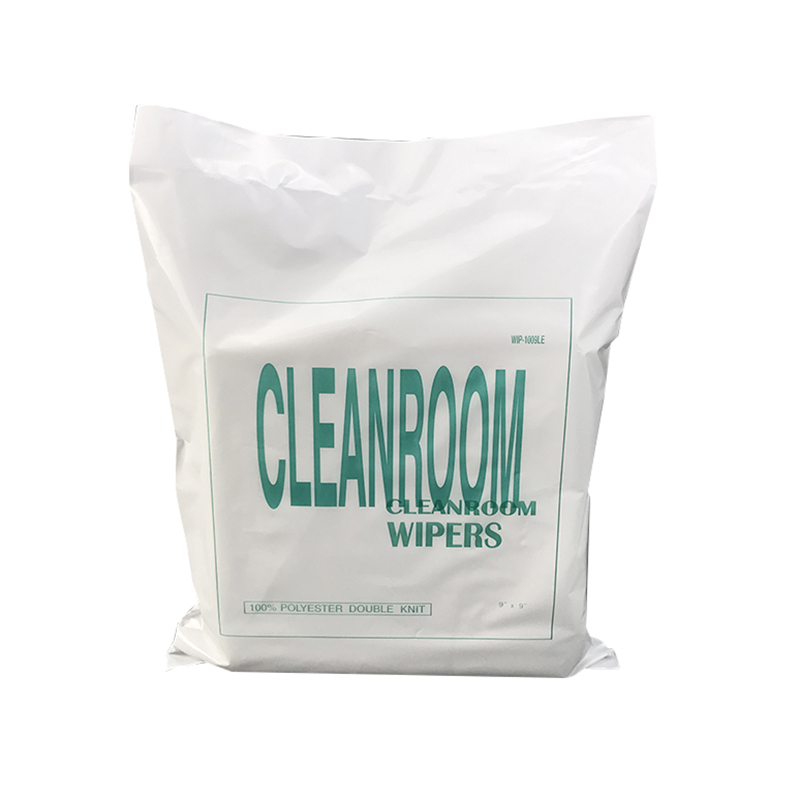
High-grade cleanroom wipes utilize 100% continuous-filament polyester or microfiber yarns rather than staple fibers. Continuous filaments run the entire length of the yarn without breaks, eliminating the loose ends that characterize conventional woven materials. Polyester knit wipes manufactured from these filaments are commonly specified for ISO Class 3–5 (Class 1–100) environments where a single stray fiber can cause catastrophic yield loss in semiconductor or optical applications.
Microfiber wipes take this further by splitting fibers into ultrafine filaments—often less than 1 denier in diameter—which increases surface area for particle capture while maintaining structural integrity. The dense network of ultrafine fibers allows mechanical removal of sub-micron particles without releasing fibers into the environment.
Edge Sealing Technologies
The cut edges of conventional wipes are the primary source of fiber release. Cleanroom wipes employ three advanced sealing methods to eliminate this risk:
- Laser-Sealed Edges – A laser beam melts and vaporizes the fabric along the cut path, simultaneously cutting and fusing the edge. This creates the cleanest seal with zero loose fibers and is preferred for ISO Class 3–4 critical applications.
- Ultrasonic-Sealed Edges – High-frequency sound waves bond the edge without adhesives or heat damage. This method produces an even finish and is particularly effective where adhesive residues must be avoided.
- Pressure Heat-Sealed Edges – Thermal bonding that prevents fiber release under aggressive scrubbing, suitable for ISO Class 5–6 environments.
By contrast, cold knife-cut or wire-cut edges leave fibers exposed and can release significant contamination during wiping. In semiconductor manufacturing, where particles in a 50–100 µm film can cause LED hot spots and lighting failure, sealed edges are treated as non-negotiable requirements.
Material Selection and Cleanroom Processing
Wipes undergo specialized laundering and packaging in cleanroom environments to remove manufacturing residues. Double-bagged vacuum packaging ensures that wipes remain uncontaminated until the moment of use. Products validated to Sterility Assurance Level (SAL) of 10⁻⁶ per ANSI/AAMI/ISO 11137:2013 guidelines guarantee that even viable microorganisms are eliminated.
Foam wipes represent an alternative approach: manufactured from polyurethane with an open-cell matrix structure, they contain no loose fibers at all. These are ideal for precision solvent application where zero fiber shedding is mandatory, such as optics cleaning or semiconductor support operations.
Precautions When Using Cleanroom Wipes with Solvents
Using cleanroom wipes with solvents requires strict adherence to compatibility verification, saturation control, and safety protocols. Improper solvent-wipe combinations can degrade materials, release particles, or create hazardous conditions that compromise both personnel safety and product integrity.
Verify Material-Solvent Compatibility
Not all wipe materials tolerate all solvents. Polyester generally exhibits excellent resistance to IPA, acetone, and most common solvents. However, cellulose components in blended wipes can swell when exposed to alcohol, potentially increasing particle generation. Microfiber performance varies by formulation, and some materials may harden or weaken under repeated solvent exposure.
| Wipe Material | IPA Compatibility | Acetone Compatibility | Risk Factors |
|---|---|---|---|
| 100% Polyester Knit | Excellent | Excellent | None significant; preferred for critical zones |
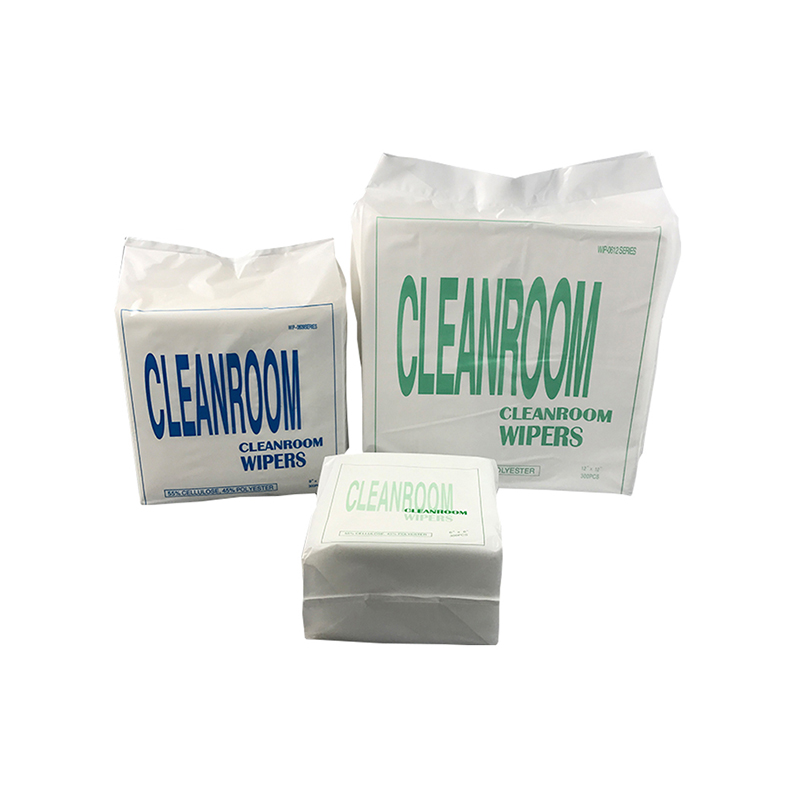
| Polyester/Cellulose Blend | Good | Good | Cellulose may swell; higher particle generation |
| Microfiber | Good to Excellent | Variable | Formulation-dependent; verify before use |
| Polyurethane Foam | Excellent | Excellent | Zero fiber shedding; controlled solvent release |
Always perform a compatibility test on a non-critical surface before deploying new wipe-solvent combinations in production areas.
Control Saturation to Prevent Re-Deposition
Research by Mattina et al. (1996) demonstrated that over-saturated wipes leave behind more contaminants than any other saturation level. When a wipe exceeds its absorption capacity, excess solution deposits onto the surface along with any particles suspended within it. This not only fails to remove existing contamination but actively adds new particles from the wipe itself.
Best practice involves dampening the wipe to a level below full capacity, allowing capillary space within the fiber structure to accommodate dislodged particles. Pre-saturated wipes—typically loaded with 70% IPA and 30% deionized water—eliminate operator variability by providing factory-controlled saturation levels.
Safety and Handling Protocols
Solvent-impregnated wipes introduce flammability and toxicity hazards that require specific controls:
- Flammability Management – IPA has a flash point of 21°C and is classified as flammable. Store pre-saturated wipes in solvent-resistant, resealable packaging away from ignition sources and direct sunlight.
- Ventilation Control – Use in adequately ventilated areas to prevent vapor accumulation. Pre-saturated wipes reduce airborne chemical exposure compared to open solvent containers.
- Personal Protective Equipment – Wear cleanroom-compatible gloves before handling wipes to prevent skin oil transfer. Avoid prolonged skin contact with solvent-laden materials.
- Proper Wiping Technique – Fold wipes into quarters to create eight clean surfaces. Wipe in unidirectional, overlapping strokes (10–25% overlap) from clean to dirty areas, flipping to a fresh surface after each stroke.
- Immediate Disposal – Discard solvent-saturated wipes immediately after use in approved waste containers to prevent chemical residue redistribution and fire hazards.
Storage and Cross-Contamination Prevention
Store wipes in original packaging on elevated shelving away from ventilation sources and entry doors. Never use open bins, which expose wipes to airborne particles. Assign specific wipe types to specific cleanroom zones using color-coding or labeled containers, and change gloves when moving between areas of different ISO classifications.
For aseptic processing environments, select wipes validated to SAL 10⁻⁶ with gamma irradiation and double-bagged packaging to maintain sterility during transfer into isolators or laminar flow hoods.
FAQ About Cleanroom Wipers
What is the difference between dry wipes and pre-saturated wipes?
Dry wipes offer flexibility for custom solvent selection but introduce operator variability in saturation levels. Pre-saturated wipes deliver consistent 70% IPA/30% DI water ratios with every use, eliminate open solvent containers, reduce VOC emissions, and improve workflow efficiency. They are particularly valuable in pharmaceutical and semiconductor environments where process repeatability is critical.
Which wipe material is best for ISO Class 3 environments?
For ISO Class 3 (Class 1) environments, laser-sealed edge polyester knit or microfiber wipes are required. These materials provide the lowest particle generation and are compatible with virtually all solvents. Avoid cellulose-based blends, which generate more particles and extractable ions.
Can cleanroom wipes be reused?
No. Cleanroom wipes are designed for single-use only. Reusing wipes redistributes captured contaminants across surfaces and defeats the purpose of contamination control. Discard immediately after the wiping surface becomes fully utilized.
Why do some wipes cause streaking on optical surfaces?
Streaking typically results from incompatible solvent-wipe combinations, over-saturation, or high non-volatile residue (NVR) content in the solvent. Use high-purity filtered IPA with low NVR specifications, and ensure the wipe is damp—not dripping—before contact with optical components.
How do I validate wipe effectiveness in my process?
Validate wipes using IEST-RP-CC004 methodologies for particle generation, ionic extractables, and non-volatile residue testing. Conduct real-world process simulations with your specific solvents and surfaces, measuring particle counts before and after wiping with a surface analyzer.