

 中文简体
中文简体 Español
 русский
 Deutsch
 Français
Content
- 1 Cleanroom Air Purity Requirements Start With One Number
- 2 Particle Limits by ISO Class
- 3 The Requirements the Class Number Does Not Cover
- 4 Where the Particles Actually Come From
- 5 Why Consumables Can Make or Break a Particle Count
- 6 Cleaning Contact Points Without Adding Particles
- 7 Verifying Compliance, and the Risks Buyers Should Check
- 8 FAQ: Cleanroom Air Purity Requirements
- 9 Matching the Numbers to the Room You Actually Run
Cleanroom Air Purity Requirements Start With One Number
A coating line in an ISO 7 area fails a routine particle count on a Tuesday morning. Nothing in the HVAC schedule changed. What changed was headcount, plus a cart of cardboard boxes that came in through the material airlock instead of the transfer hatch.
Here is the short version. Cleanroom air purity requirements are written as a maximum number of particles of a given size per cubic meter of air, and that ceiling is set by the ISO class of the room. ISO 5 allows no more than 3,520 particles of 0.5 µm or larger per cubic meter. ISO 8 allows 3,520,000. Filtration, air change rate, room pressure, gowning, wipers, swabs and entry mats all exist for one reason: to keep the room inside that number while people are working in it.
A useful specification therefore contains three items, not one. It states the particle size the class is based on, the occupancy state at which the limit must be met (as built, at rest, or in operation), and the test method used to prove it. ISO 14644-1 has been the international reference since it replaced US Federal Standard 209E, which was cancelled in 2001, although "Class 100" and "Class 10,000" still appear as shorthand on older drawings.
The class number is a target, not a solution. Whether you hit it depends on how much air you move, how well you filter it, how pressure is balanced between rooms, and how much contamination people and materials bring through the door.
Particle Limits by ISO Class
The four classes below cover most electronics, medical device, optical and packaging applications. Each step toward a cleaner class allows one tenth as many particles as the class below it.
| ISO Class | Particles ≥ 0.5 µm per m³ | Particles ≥ 5.0 µm per m³ | Legacy FED STD 209E |
|---|---|---|---|
| ISO 5 | 3,520 | 29 | Class 100 |
| ISO 6 | 35,200 | 293 | Class 1,000 |
| ISO 7 | 352,000 | 2,930 | Class 10,000 |
| ISO 8 | 3,520,000 | 29,300 | Class 100,000 |
Bar heights are plotted on a logarithmic scale, so a visually similar step represents a ten-fold change in the allowed particle count.
The ten-fold step matters when you compare quotations. A wiper that is perfectly acceptable in an ISO 8 warehouse may shed far too many fibers beside an ISO 5 coating station. The same logic applies to garments, gloves, notebooks and cleanroom printing paper.
Note what the standard does not say. ISO 14644-1 sets concentration limits and the method for verifying them. It does not decide which class your process needs, how often to sample, or how much air to supply. Those decisions belong to your process owner, your customer specification and, in regulated industries, to the applicable GMP or USP requirement.
The Requirements the Class Number Does Not Cover
Air change rate and filtration
ISO 14644-1 does not specify air changes per hour. Design guidance for occupied rooms commonly falls in these ranges:
- ISO 5: roughly 240 to 480 air changes per hour, usually with ULPA filtration and unidirectional flow at the critical zone
- ISO 6: roughly 150 to 240 air changes per hour
- ISO 7: roughly 60 to 150 air changes per hour
- ISO 8: roughly 5 to 60 air changes per hour
Treat those figures as design starting points, not as standard requirements. The reliable proof is a recovery test: how quickly the room returns to its class limit after a contamination event, together with a particle count taken while the room is in operation.
Pressure, temperature and humidity
Adjacent rooms are normally held at a 10 to 15 Pa differential so air moves from cleaner to less clean areas rather than the reverse. Temperature between 18 and 22 °C and relative humidity between 30 and 60 percent are common where static-sensitive product is handled: very dry air increases static build-up, while high humidity raises corrosion and microbial growth risk. Neither value comes from the ISO classification itself.
Microbiological and industry-specific limits
Pharmaceutical manufacturing adds viable particle limits under EU GMP Annex 1 and ISO 14698. Semiconductor fabs also control airborne molecular contamination, addressed by ISO 14644-8, and compounding pharmacies work to USP 797 and USP 800. Where your product is regulated, the ISO class is the floor rather than the ceiling.
Where the Particles Actually Come From
Filtration gets the attention, but people generate the particles. An adult walking in street clothes releases millions of particles per minute; a properly gowned operator releases a small fraction of that, and movement and speech still push the count up. Industry estimates of contamination sources in an operating cleanroom usually look something like this.
- People and gowning — about 70%
- Equipment and process — about 15%
- Materials and consumables — about 10%
- Air supply and facility — about 5%
The practical consequence is simple: entry control is purity control. Tacky mats at the airlock, a gowning sequence that is audited rather than assumed, and a clear rule about which goods come through which door will protect your particle count more reliably than adding filter capacity.
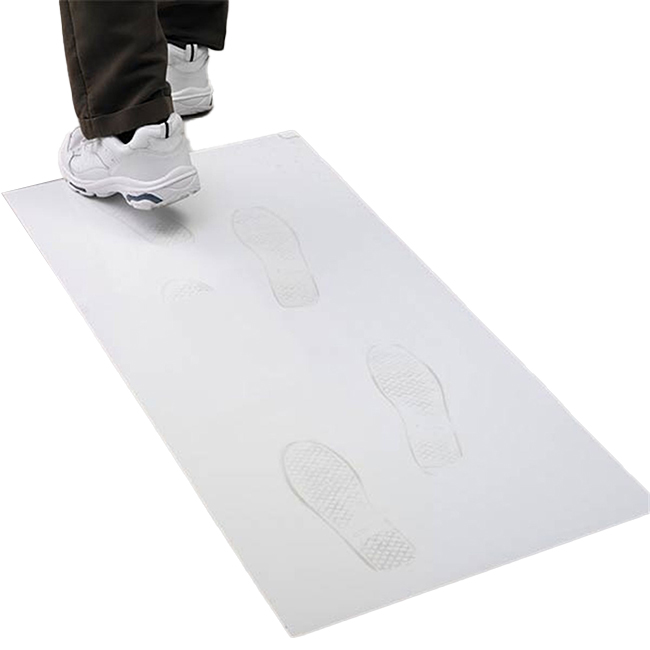 Sticky MatDisposable sticky mat is a self-adhesive dust-removing product formed by the multi-layer Low Density Polyethylene Film materials.it is constructed with 30 layers, each...View Product →
A tacky mat is a low-cost consumable. A failed particle count during a customer audit is not.
Why Consumables Can Make or Break a Particle Count
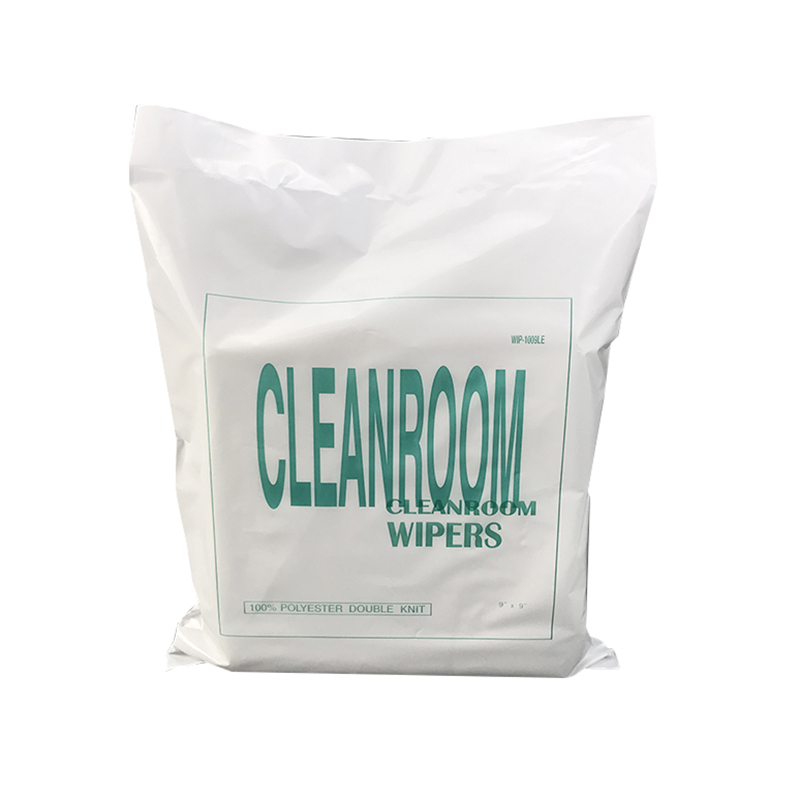
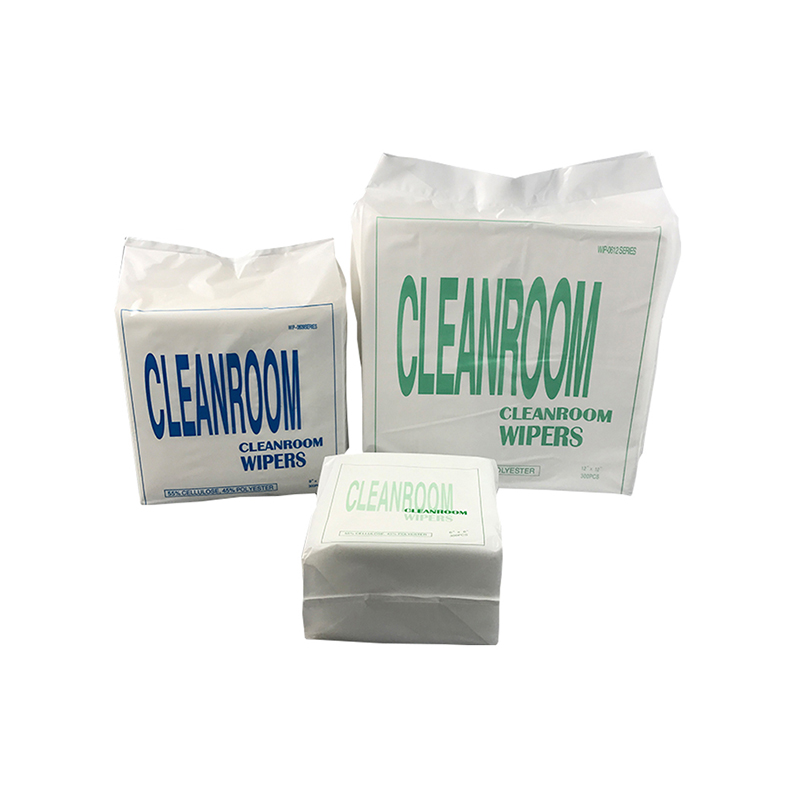
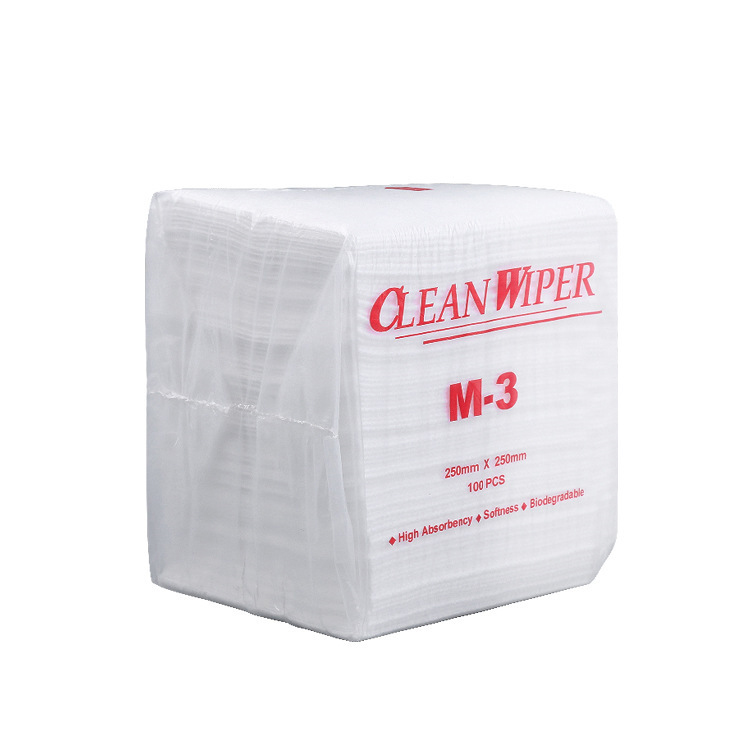
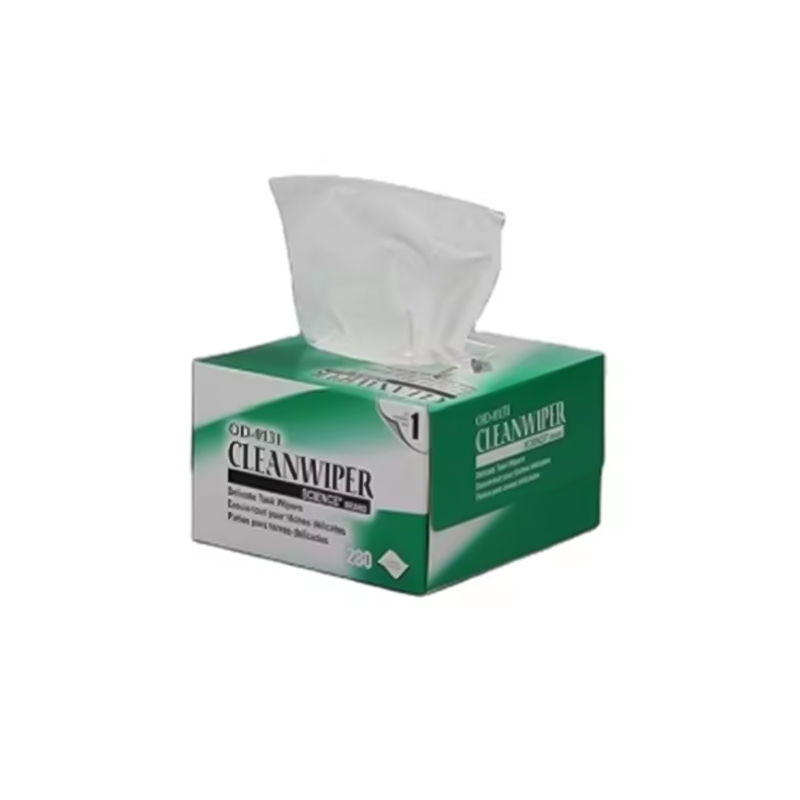
A wipe used in an ISO 7 room is not the same product as a household cloth. Cleanroom wipers are knitted or nonwoven, cut with laser or ultrasonic sealed edges instead of sheared edges, laundered in a controlled facility, and packed in cleanroom-compatible packaging. The differences show up as particle release, fiber release and extractables, and they show up on your particle counter. If you want the mechanics of that release in detail, this note on whether a cleanroom wiper releases more particles during cleaning is a useful reference.
How you wipe matters as much as what you wipe with. A single-direction stroke with a folded wiper releases less than a scrubbing motion, and reusing the same face of the wiper spreads contamination instead of removing it. For benches, equipment housings and laminar flow hoods, polyester wipers are the usual choice because they combine low shedding with good solvent resistance and repeated rinsing.
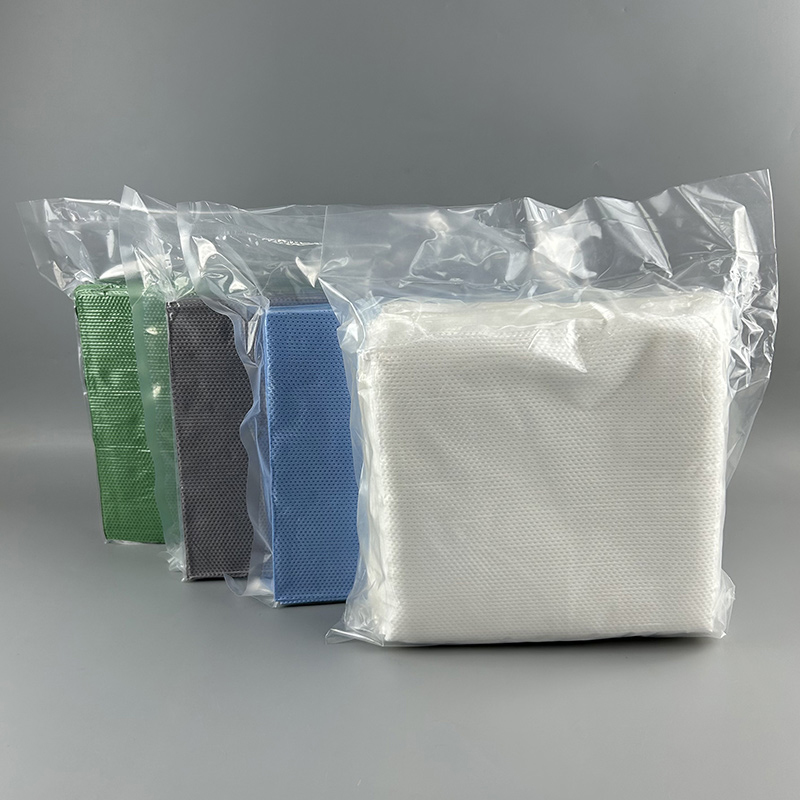 JW-24011 2 Ply Polyester Cleanroom Wiper2 Ply polyester cleanroom wiper is made of polyester fiber, laminated with two layers through ultrasonic composite.View Product →
Two-ply polyester wipers in this style are specified by weight, edge treatment and the class of the laundry that processed them. A laundry that runs at ISO Class 5 or Class 6 output will typically deliver a lower particle and fiber count than one washing general industrial textiles.
Cleaning Contact Points Without Adding Particles
Swabs are the consumables that touch what you cannot afford to contaminate: sensor windows, print heads, fiber optic ferrules, small cavities and the inside of precision instruments. Two decisions dominate the selection.
- Tip material: knitted polyester resists abrasion and suits scrubbing, open-cell foam holds solvent and releases it gradually, while sponge and cotton are cheaper and generally shed more.
- Handle material: polypropylene handles clean up well and are common in electronics, while paper or wood handles are usually reserved for lower-class areas.
Then the swab's cleanliness becomes the cleanliness of the surface it touches. A swab with a loose edge or a poorly bonded tip deposits particles and adhesive residue exactly where the incoming inspection microscope is pointed.
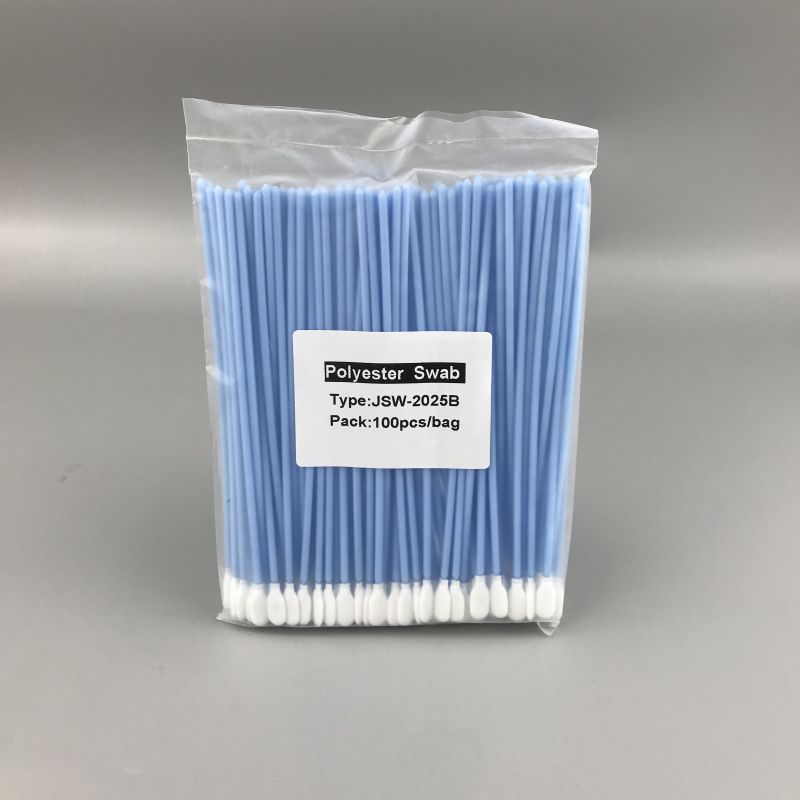 JSW-2025C Lint Free Polyester Cleaning SwabLint free polyester cleaning swab is produced using automated processes that thermally bond knitted polyester fibers. They exhibit strong resistance to solvents and ar...View Product →
Lint-free polyester swabs are a sensible default for precision surfaces in ISO 5 to ISO 7 areas: the knit tip holds up to light pressure, and the sealed edge keeps fiber release low.
Verifying Compliance, and the Risks Buyers Should Check
Classification is verified by counting particles at defined locations. ISO 14644-3 describes the test methods, including the particle count test, HEPA filter leak testing, airflow visualization and recovery testing. The number of sampling locations for a classification test is derived from the floor area, approximately the square root of the area in square meters with no fewer than two locations, and each location is sampled at working height.
When you compare certificates from suppliers or contractors, check three things:
- The occupancy state. A report marked "as built" says almost nothing about how the room behaves with people, carts and equipment inside it.
- The particle size. A class verified only at 0.5 µm does not describe 0.3 µm behavior, which matters in lithography and some optical work.
- The test date and instrument calibration. An expired report is a purchasing risk, not evidence.
Compressed air and process gases deserve the same attention as room air. A room can pass its particle count while the air blowing onto the product at a workstation carries oil aerosol, moisture or particles from a compressor that was never tested to the same class.
FAQ: Cleanroom Air Purity Requirements
Is ISO 5 the same as Class 100?
They are close but not identical, and FED STD 209E was cancelled in 2001. ISO 5 means no more than 3,520 particles of 0.5 µm or larger per cubic meter; Class 100 meant no more than 100 particles of 0.5 µm or larger per cubic foot. The limits are approximately equivalent, but ISO 14644-1 is the reference to cite today.
What is the minimum ISO class a cleanroom needs?
There is no universal minimum. The class follows the product: ISO 5 or cleaner for critical semiconductor and optical processes, ISO 7 or ISO 8 for many assembly, packaging and medical device operations, and ISO 9 where the space is controlled but not truly clean.
Do particle counts prove air purity?
They prove the classification. They do not cover viable contamination, chemical contamination, static or the additional limits a customer specification may impose. Treat the count as one line of evidence inside a larger validation package.
How often should a cleanroom be classified?
ISO 14644-2 ties monitoring frequency to risk. A common pattern is a full classification test every 6 to 12 months, periodic particle monitoring in between, and retesting after any change to filters, layout or process equipment.
Matching the Numbers to the Room You Actually Run
Cleanroom air purity requirements are easy to state and hard to hold: a concentration limit, at a defined particle size, in a defined occupancy state. The limit is reached through filtration and air movement, and it is protected by small things, including entry mats, sealed-edge wipers, low-shedding swabs and a gowning routine that is checked rather than assumed.
If you are specifying consumables for an ISO 5 to ISO 8 room, start from particle release data and the surface being cleaned rather than from unit price. Send us the class, the surface and the solvent, and we will recommend the wiper, swab or mat that fits the requirement instead of the one that merely fits the budget.