

 中文简体
中文简体 Español
 русский
 Deutsch
 Français
Content
An operator walks from the loading dock across a polished concrete corridor and into your assembly bay. Along the way, each shoe sole picks up fibers, grit, and skin flakes — and deposits them just inside your controlled space, where foot traffic and airflow lift them back toward your product. A sticky floor mat at the doorway stops most of that transfer at the threshold. It is one of the least expensive contamination control tools you can install, and when it is sized, placed, and maintained correctly, it protects every cleaning investment you have made downstream. This guide explains how sticky mats work, which specifications actually matter when you buy them, and how to run them day to day so they deliver the particle reduction they promise.
What a Sticky Floor Mat Is and How It Works
A sticky floor mat — also listed by suppliers as a tacky mat or cleanroom mat — is a stack of adhesive-coated film sheets, most commonly 30 layers deep, placed at the entrances and exits where particles hitch a ride on shoes, trolley wheels, and cart casters. When a sole presses down, loose particles transfer to the exposed adhesive layer. When that layer is saturated, an operator peels it away from the corner tab and the next clean layer is ready immediately. No chemicals, no power, and no cleaning crew required.
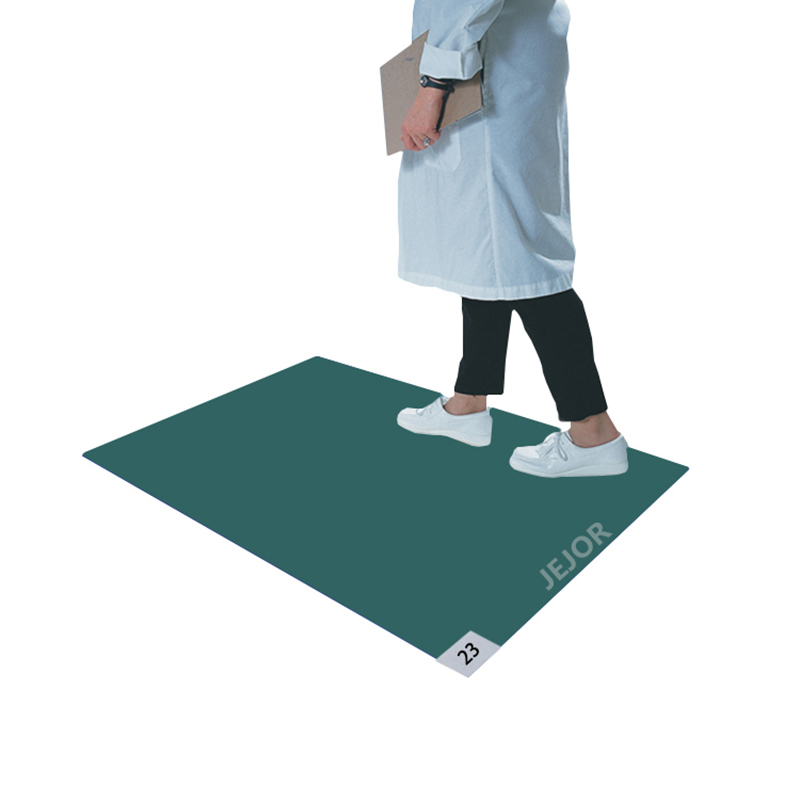 30-Layer Adhesive Sticky Mat for Cleanroom EntrancesA multi-layer LDPE tacky mat that traps particles from soles and wheels; each saturated sheet peels away to reveal a fresh layer, with no power or chemicals needed.View Product →
Three mechanical points are worth understanding before you compare suppliers or quotes:
- Adhesion does the work. The film is not a wipe; it grabs particles on contact, so effectiveness depends on tack level and contact pressure rather than absorbency.
- Coverage decides the outcome. The mat only cleans what it touches, so width and walking path matter more than thickness.
- Layer count sets service life. A 30-layer pad gives you 30 changeouts before the pad itself is replaced, which is the fairest way to compare cost between offers.
Why the Entrance Decides Your Cleanroom Results
Personnel remain the largest contamination source in most controlled environments — commonly estimated at around 78% of total particle generation, with equipment and process exhausts accounting for most of the remainder. A large share of that contribution happens at the door, because outdoor flooring carries a heavy particle load and every footstep crossing the threshold can leave thousands of particles on the clean side.
- Personnel: about 78%
- Equipment and process: about 15%
- Other sources: about 7%
A sticky mat does not replace gowning, air showers, or shoe covers — it is the final physical barrier between the outside floor and your clean floor, and it works alongside them. The same logic applies deeper in the facility: floors, walls, and work surfaces each need their own consumable. For that wider picture, it helps to understand what role antistatic dust-free cloth plays inside the workshop once particles have already made it past the entrance.
Specifications to Check Before You Buy
Suppliers vary mainly on six points. Compare them line by line before you request a quote, because two mats with the same footprint can behave very differently in service.
| Specification | Typical Range | Why It Matters |
|---|---|---|
| Layer count | 24-60 sheets per pad | More layers mean fewer pad changes and more predictable cost per day |
| Sheet size | 600 x 1200 mm and 900 x 1200 mm are common | The mat must cover the full doorway width so nobody can step around it |
| Adhesion level | High, medium, or low tack | High tack suits heavy traffic and gritty corridors; low tack is easier on wheels and lighter soils |
| Color | Blue, white, or clear | Blue makes soiled areas easy to spot at a glance; white suits facilities that audit for visible lint |
| ESD-safe option | Static-dissipative film | Required where bare boards or static-sensitive components pass through the entrance |
| Mounting | Reusable frame or adhesive-back pad | A frame keeps edges flat and reduces trip risk; frameless pads suit temporary or low-traffic zones |
Get the geometry right first. A workable rule is that the mat should be wide enough that a person cannot step over or around it, and deep enough that each foot lands on it at least twice — which in practice means full doorway width plus two to three stride-lengths of depth. For a standard 900 mm door, two 600 x 1200 mm mats placed side by side cover this well.
Patterned tops are another option. A basketball-pattern sticky mat, for example, makes the intended walk path obvious to visitors and new staff, which quietly raises the share of people who actually cross the film instead of skirting it.
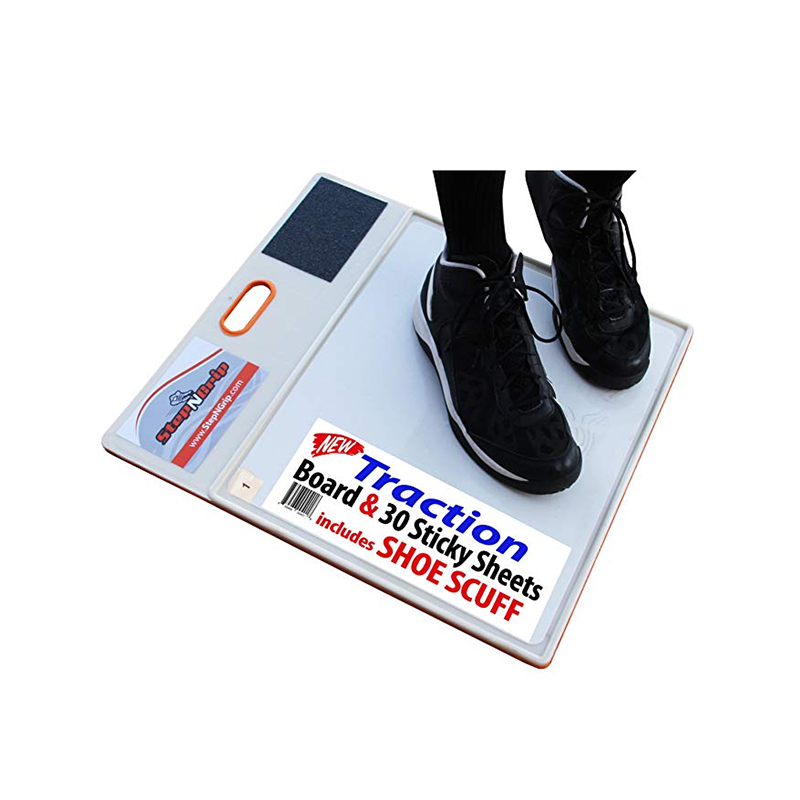 Basketball-Pattern Sticky Mat with Visible Walk PathThe printed pattern makes the intended tread path obvious to visitors and new staff, increasing the share of people who actually cross the adhesive film instead of skirting it.View Product →
Placement, Daily Use, and When to Peel
Place the mat after gowning and immediately before the cleanroom door, so the last thing feet touch before entry is adhesive film rather than a soiled corridor. In pharmaceutical and chemical plants, a second mat at the exit prevents hazardous residues from being tracked outward. Once installed, ask staff to walk at a normal pace and take two to three full steps across the film — shuffling in place on one spot does far less work than a full stride.
Peel a layer when it is visibly soiled or when the surface no longer feels tacky to a gloved fingertip. A simple routine keeps performance steady:
- Check the mat at every shift start and after any delivery trolley has crossed it.
- Peel slowly from the corner tab, pulling flat and low toward the far edge so trapped dust does not flick into the air.
- Log the changeout; if one entrance needs several peels per shift, move up to a higher-tack film or add a second mat.
- Keep trolley wheels clean so grit does not slice the film, and never mop or spray the adhesive surface.
Pair Mats with Sticky Rollers for Full Coverage
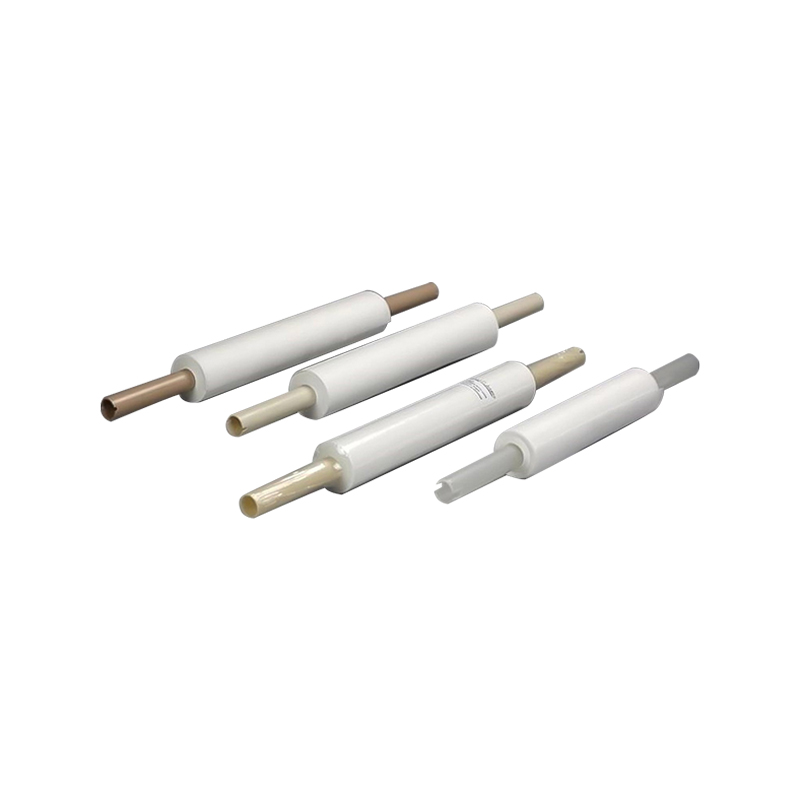
Floors are only one surface in the particle path. Sticky rollers extend the same peel-and-capture logic to walls, work surfaces, equipment panels, softwall curtains, and even gowning garments between laundering cycles. PE film rollers handle general surfaces, silicone rollers suit precision optics and screens, and antistatic rubber rollers are the match for ESD-protected zones. Used together, a mat at the door and rollers at the workbenches cover the two surfaces that touch your product most often.
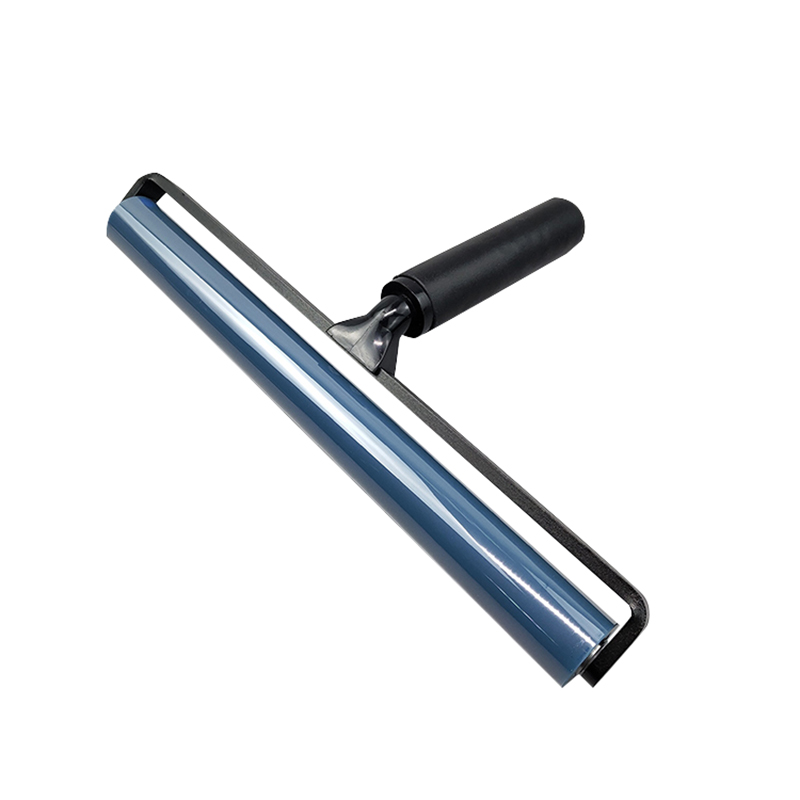 Sticky Rollers for Walls, Work Surfaces, and EquipmentExtends peel-and-capture dust removal beyond floors; PE, silicone, and antistatic rubber roller options match general surfaces, precision optics, and ESD-protected zones.View Product →
Frequently Asked Questions
How long does one sticky mat last?
There is no fixed calendar life; consumption follows traffic. A busy material airlock can exhaust a 30-layer pad in one to two weeks, while a low-traffic support entrance may run for a month or more. Judge by soil load and remaining tack, not by dates.
Do sticky mats control static?
No. A standard mat captures particles only. Where electronics pass through, choose an ESD-safe film and remember that the mat supplements — not replaces — dissipative flooring, ESD footwear, and wrist straps at the same entrance.
Can I use one outside a cleanroom?
Yes. Hospitals, laboratories, paint booths, data centers, and site offices all use sticky mats anywhere tracked-in particles create cost. The threshold logic is identical whether or not the space has a formal cleanliness classification.
Frame or frameless?
Choose a frame for permanent entrances with trolley traffic, because it holds the pad flat and the edges down. Frameless adhesive-back pads are lighter and cheaper, and they suit temporary zones or doorways where a fixed frame would be in the way.
If you are building out an entrance control program and need help matching mat size, tack level, and rollers to your traffic and cleanliness class, send us your doorway dimensions and shift pattern — you can request a quote and our team will recommend a configuration based on how your facility actually runs.