

 中文简体
中文简体 Español
 русский
 Deutsch
 Français
Content
- 1 Why a Gowning SOP Is the First Control Barrier
- 2 ISO Cleanroom Classes and What They Demand From Gowning
- 3 Pre-Gowning Preparation: Before the First Hairnet
- 4 Step-by-Step Cleanroom Gowning Procedure
- 5 De-Gowning: Removing Risk Instead of Spreading It
- 6 Common Gowning Mistakes Found in Audits
- 7 How to Select Garments That Support the SOP
- 8 FAQ: Gowning Procedure SOP Questions
- 9 Keep the SOP Alive
A medical device manufacturer lost an entire syringe batch when an operator entered the ISO Class 6 filling room with a torn glove. The bioburden investigation ended at a gowning violation, and the corrective action was simple: rewrite the gowning SOP and retrain the team.
That story shows why the gowning procedure SOP is the primary barrier between people and product in any cleanroom. This guide explains what a complete cleanroom gowning SOP should contain, from preparation and donning to de-gowning, common mistakes, garment selection, and the ISO standards that give each step its purpose.
Why a Gowning SOP Is the First Control Barrier
The conclusion first: operators are the largest particle source in an occupied cleanroom, and a consistent gowning SOP is the most effective control. A person at rest sheds about 100,000 particles per minute at sizes over 0.3 µm. Walking pushes that above 5 million per minute. A correctly ordered cleanroom garment system traps most of that shedding close to the body.
Personnel-generated contamination breaks into four approximate sources:
- Skin and garment shedding 74%
- Respiratory and saliva 12%
- Hair 8%
- Cosmetics and jewelry 6%
The routine matters as much as the garments. When every operator follows the same sequence, audits are repeatable, particle counts stabilize, and excursions have fewer variables to investigate.
ISO Cleanroom Classes and What They Demand From Gowning
ISO 14644-1 classifies cleanrooms by airborne particle concentration, not by gowning procedure. The target class, however, drives the gowning requirement: cleaner rooms need more coverage. The table below lists the maximum particle concentrations from ISO 14644-1:2015 and the typical gowning coverage used in practice.
| ISO Class | Max particles per m³ (≥0.5 µm) | Typical gowning coverage |
|---|---|---|
| ISO 5 | 3,520 | Full coverall, hood, beard cover, goggles, double gloves, boot covers |
| ISO 6 | 35,200 | Gown or coverall, hood, beard cover, single or double gloves, boot covers |
| ISO 7 | 352,000 | Smock or frock, hairnet, beard cover, shoe covers |
| ISO 8 | 3,520,000 | Smock, hairnet, shoe covers where local policy applies |
Logarithmic scale; values are maximum permitted particles ≥0.5 µm per cubic meter.
The practical point for an SOP: write gowning rules per room class. An ISO 5 photolithography bay typically requires a full coverall, hood, goggles, and double gloves; an ISO 7 assembly line can operate with a gown, a hairnet, and one pair of gloves. One universal procedure usually causes over-gowning in some rooms and under-gowning in others.
Pre-Gowning Preparation: Before the First Hairnet
Most gowning failures begin before anyone touches a cleanroom garment. Jewelry, cosmetics, and personal clothing carry particles and microbes that no gown can fully enclose, so the SOP must define a preparation stage, not just a dressing stage.
- Remove all jewelry: rings, watches, necklaces, and earrings. They trap contaminants and puncture gloves.
- Remove cosmetics, perfume, and hair gel. Tiny particles from these products stay suspended in the air for hours.
- Do not wear shedding personal garments. Wool sweaters, scarves, and fleece release fibers that the cleanroom gown cannot contain.
- Wash hands and forearms with antimicrobial soap and dry them with lint-free towels.
- Keep fingernails short and free of polish in pharmaceutical and medical device cleanrooms.
- Complete a health self-check. In ISO 5 areas, operators with cold symptoms, wet coughs, or open wounds should not enter, or should be moved to non-critical duties.
The gowning room also needs a step-over bench and a full-length mirror. The bench separates the street-shoe side from the clean side; operators never sit on the clean side because sitting compresses the gown and generates particles.
Step-by-Step Cleanroom Gowning Procedure
The working rule is to dress from top to bottom and never let a gowned surface touch an ungowned surface. When every operator repeats the same order, particle transfer stays minimal.
- Wash and dry hands and forearms with antimicrobial soap and lint-free towels immediately before entering the gowning room.
- Don the hairnet or hood first. Tuck in all hair, including sideburns and the back of the neck.
- Don the beard cover, overlapping the hairnet edge if both are required.
- Don the face mask over the nose and chin; shape the nose clip for a sealed fit.
- If double gloving for ISO 5, put on the first pair of gloves now; the gown sleeves will cover the cuffs.
- Don the cleanroom gown, letting the sleeves cover the first glove cuffs. For ESD-sensitive production, choose an ESD gown with turndown collar
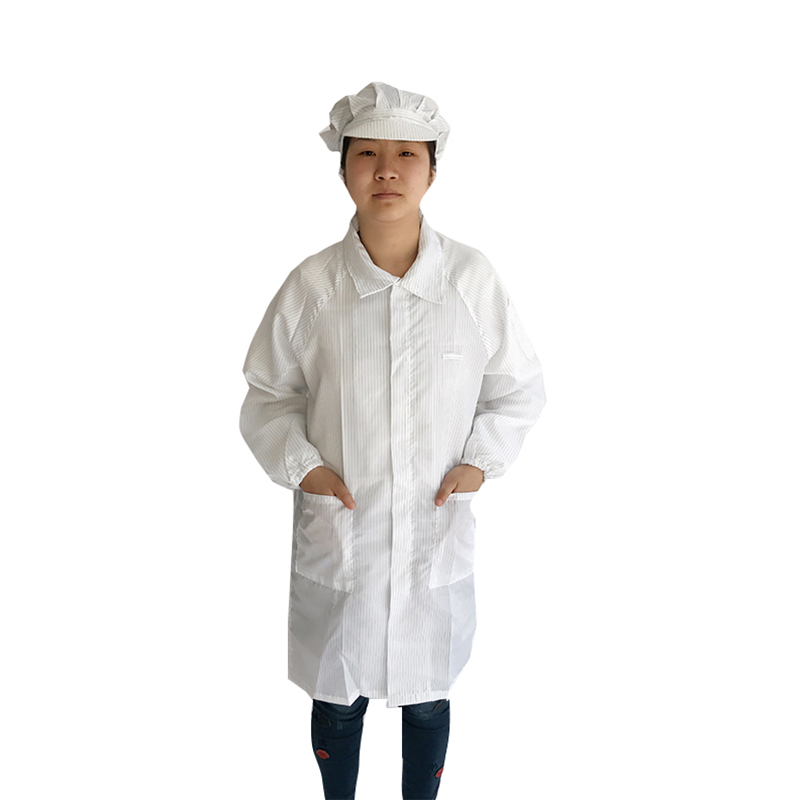 Custom ESD Gown Turndown Collar Suppliers, OEM/ODM Factory - Suzhou Jujie ElectrSuzhou Jujie Electron Co.,Ltd is a China OEM/ODM ESD Gown Turndown Collar supplier and ESD Gown Turndown Collar factory, We specialize in...View Product → so the conductive grid remains continuous to the collar.
 - Don boot covers or switch into cleanroom boots, tucking the gown leg cuffs inside.
- Don the second pair of gloves, or the only pair for ISO 6 and 7 rooms. Use cleanroom ESD gloves
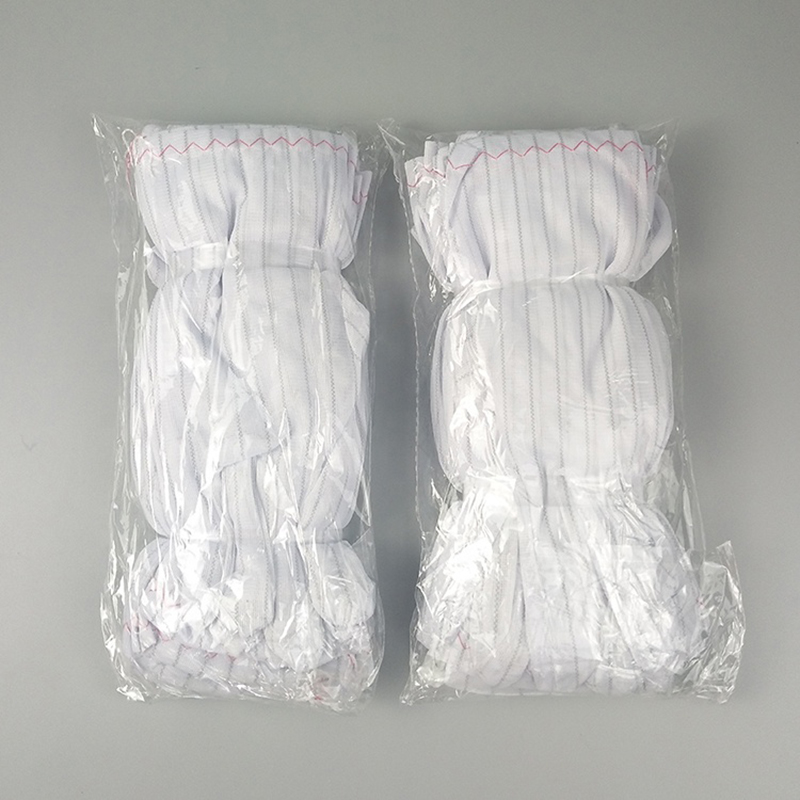 Custom ESD Gloves Suppliers, OEM/ODM Factory - Suzhou Jujie Electron Co.,LtdSuzhou Jujie Electron Co.,Ltd is a China OEM/ODM ESD Gloves supplier and ESD Gloves factory, We specialize in custom ESD Gloves and other...View Product → for electronics assembly, and pull the glove cuffs over the gown sleeves.
 - Don goggles or a face shield over the hood when the SOP requires it.
- Walk across sticky mats
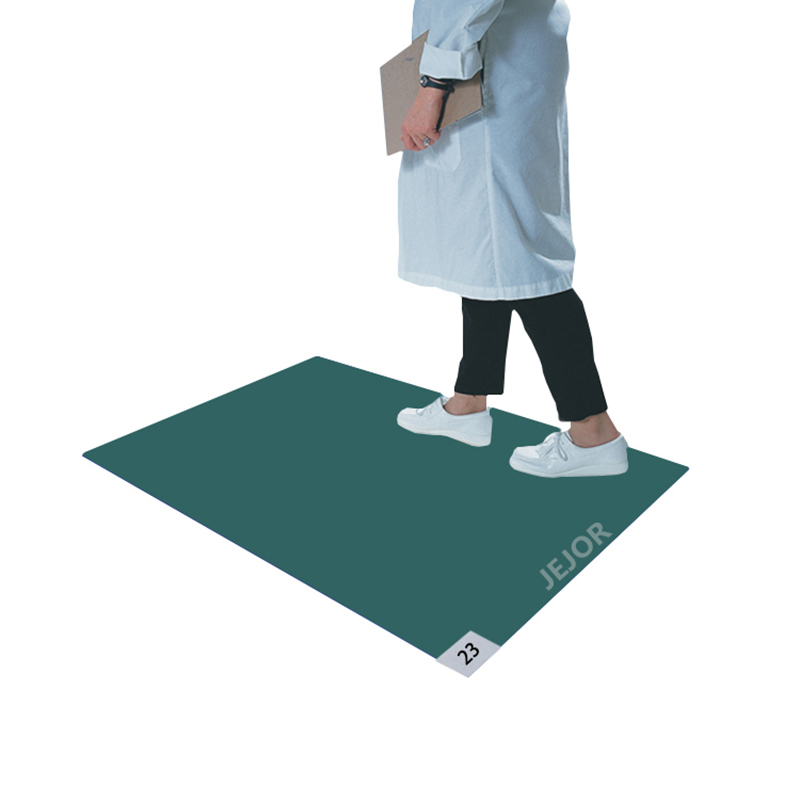 Custom Sticky Mat Suppliers, OEM/ODM Factory - Suzhou Jujie Electron Co.,LtdSuzhou Jujie Electron Co.,Ltd is a China OEM/ODM Sticky Mat supplier and Sticky Mat factory, We specialize in custom Sticky Mat and other...View Product → or through the air shower at the cleanroom entrance. Keep your hands above waist level and do not touch the mask or gown while moving.
Checks Before Entry
Stand at the mirror and verify: no exposed hair, mask edge inside the gown collar, gloves fully covering the cuffs, and boot covers without folds that can trip or tear. The check takes about fifteen seconds and prevents the most common entry-time violations.
De-Gowning: Removing Risk Instead of Spreading It
De-gowning is not the reverse of gowning. It is a containment procedure: contamination stays on the operator, the next set of garments stays clean, and the outer corridor stays uncontaminated.
- Remove the outer gloves first and discard them. They are the most contaminated surface on your body.
- Remove goggles and place them in the designated collection tray for cleaning, or discard disposables.
- Remove boot covers one at a time, turning them inside out, and discard.
- Unzip the gown and peel it from the shoulders, turning it inside out. Do not shake the fabric. Place it in the laundry bin or waste bin.
- Remove the mask, beard cover, and hairnet last, in that order.
- Wash hands and forearms after leaving the cleanroom area.
Reusable garments go into closed laundry containers that follow a certified cleanroom laundering process. Operators never take used garments home, and single-use items are never reworn.
Common Gowning Mistakes Found in Audits
Even experienced operators repeat the same errors. Make these items part of the routine inspection list:
- Touching the face, mask, or hair inside the cleanroom; the glove then transfers skin oils and particles to the product.
- Sitting on the gowning room bench in full gown, compressing the fabric and raising particle shedding later.
- Rolling sleeves up during gowning, which releases fiber particles from the folds.
- Wearing a phone or smartwatch under the gown; these devices trap and shed particles.
- Reusing disposable shoe covers between rooms or between shifts.
- Removing gloves with a snap of the wrist instead of the peel method; the snap can tear the second glove.
- Skipping the mirror check after an interruption, such as answering a phone call or restocking a gowning cabinet.
The fix is the same for all of these: short, frequent re-qualifications with direct feedback, and particle data shared openly with the team.
How to Select Garments That Support the SOP
The SOP is only as good as the garments it specifies. Base purchasing decisions on your ISO class and process sensitivity, and ask suppliers for particle data before committing to a product.
- Fabric type: polyester-based low-shedding fabrics with carbon fiber filaments are the cleanroom standard. Cotton is not acceptable above ISO 8 because it sheds fibers and holds moisture.
- Woven versus knitted: woven fabrics do not stretch and release fewer particles, which is why ISO 5 coveralls are usually woven. Knitted fabrics are more comfortable and economical for ISO 6 to 8 gowns.
- Seam construction: bound seams and covered closures prevent particle escape through stitching holes. Look for sealed seams or ultrasonic welding on critical styles.
- ESD performance: electronic assembly lines require garments that control static charge, not just particles. The carbon fiber grid dissipates charge when the garment is grounded through the shoe and wrist strap system. The technical overview of antistatic dust-free cloth explains the common fabric constructions in more detail.
- Reusable versus single-use: reusable polyester garments lower cost per use and reduce waste when the laundry contract maintains cleanroom-grade quality; single-use garments simplify logistics and remove laundry variability.
For ISO 6 and ISO 7 environments, a practical starting point is a polyester ESD gown, ESD gloves, and floor-level particle control at the entrance. These are consumables with measurable quality differences across suppliers, so test samples before changing vendors.
FAQ: Gowning Procedure SOP Questions
How often should gowning training be repeated?
The common baseline is annual re-qualification after initial training. ISO 5 facilities often add quarterly observation, where a supervisor grades the donning sequence and gives immediate feedback.
Can cleanroom gowns be reused?
Yes, when the garment is certified reusable. The laundry provider must follow a validated process with a documented cycle limit, usually 50 to 100 washes. Inspect each gown before use and remove it from service at the first visible defect.
Is double gloving mandatory in ISO 6?
Not by ISO 14644. Your quality risk assessment sets the rule. Aseptic filling lines in ISO 6 usually double-glove; inspection and assembly lines usually run with a single pair.
Why is the order head to toe?
The head and face shed the most particles and droplets. Covering them first means falling material is caught by the gown rather than landing on a partially dressed body, and the mask edge seals inside the gown collar.
What besides the steps belongs in a gowning SOP?
Entry and exit rules, garment specifications, laundry and storage instructions, training records, audit frequency, and a defect-reporting channel. Many plants add a worn-garment inspection checklist and a posted flow chart in the gowning room.
Keep the SOP Alive
The best gowning SOPs are living documents: reviewed after every excursion, updated when a new garment is qualified, and audited quarterly. Post the document inside the gowning room and train to it, not just at onboarding but continuously.
If you are building or revising a gowning program now, ask suppliers for particle data and samples before you commit. Our technical team can review your current gowning practice and recommend suitable cleanroom gowns, ESD gloves, and entrance mats. Contact our technical team to start the conversation.