

 中文简体
中文简体 Español
 русский
 Deutsch
 Français
Content
- 1 What Separates a Cleanroom Wiper from a Microfiber Cloth?
- 2 Performance Comparison: Cleanroom Wiper vs Microfiber Cloth
- 3 When a Cleanroom Microfiber Wiper Is the Better Choice
- 4 When a Standard Polyester Cleanroom Wiper Still Makes Sense
- 5 Don't Overlook ESD and Edge Treatment
- 6 How to Choose: A Practical Selection Guide
- 7 Common Procurement Mistakes to Avoid
- 8 Frequently Asked Questions
- 9 Final Recommendation
A process engineer in a semiconductor fab recently asked whether the team could replace cleanroom wipers with ordinary microfiber cloths to cut consumable costs. The immediate answer was: not without risking yield. A cleanroom wiper and a commercial microfiber cloth may look similar, but differences in fiber structure, laundering, edge sealing, and verification testing determine how many particles and ions they leave behind. This article compares the two across the criteria that actually matter — particle load, absorbency, chemical compatibility, electrostatic behavior, and total cost — so you can match the right wipe to your ISO class and cleaning task.
What Separates a Cleanroom Wiper from a Microfiber Cloth?
The defining difference is not the material name; it is the manufacturing and verification procedure. A cleanroom wiper is knitted or woven from controlled fibers, laundered in deionized (DI) water, cut with sealed edges, and packaged inside a certified cleanroom. Each lot is tested for particles, fibers, non-volatile residue (NVR), and ionic contamination against a published specification such as IEST-RP-CC004. A consumer microfiber cloth receives none of that treatment.
How a Cleanroom Wiper Is Manufactured
Cleanroom wipers begin as continuous filaments of polyester or microfiber that are knitted into a smooth, low-lint fabric. The fabric is laundered in DI water to remove spinning oils, salts, and process residues; sealed by laser, ultrasonic, or thermal cutting so that edges do not release fibers; and double-bagged inside a cleanroom. The finished wiper carries a verified spec sheet for particles, extractables, and ionic content.
What Microfiber Actually Brings
Microfiber refers to filaments finer than one denier, typically a split blend of polyester and polyamide. Splitting creates wedge-shaped spaces between ultra-fine filaments, which act like tiny capillaries that pull liquid and particles into the fabric. A cleanroom-grade microfiber wiper combines this capture mechanism with controlled laundering and testing; a store-bought microfiber cloth does not.
Performance Comparison: Cleanroom Wiper vs Microfiber Cloth
To judge which product belongs in your cleaning protocol, compare the properties below. Values are representative ranges from published wiper spec sheets; always confirm against the supplier's verified data.
| Property | Cotton Rag | Consumer Microfiber Cloth | Polyester Knit Cleanroom Wiper | Cleanroom Microfiber Wiper |
|---|---|---|---|---|
| Particle shedding (0.5 µm and above) | High | Medium | Low | Very low |
| Absorbency per gram | Moderate | High | Moderate | Very high |
| Ionic and NVR residue | High | High | Low | Low |
| Edge treatment | Raw cut | Raw or serged | Sealed | Sealed |
| Solvent compatibility | Limited | Limited | Wide | Moderate |
| Reusable after validated laundering | No | No | Yes | Yes |
| Relative cost per wipe | Lowest | Low | Moderate | Highest |
When a Cleanroom Microfiber Wiper Is the Better Choice
For final cleaning of optical lenses, image sensors, coated panels, and other delicate surfaces, a cleanroom microfiber wiper outperforms both consumer cloths and standard polyester wipers. Its ultra-fine filaments capture sub-micron particles and hold them inside the fabric instead of pushing them across the surface.
- Fine particle capture: split microfiber filaments trap particles below 0.5 µm more effectively than standard polyester knit.
- High absorption rate: capillary action pulls liquids into the fabric quickly, reducing streaking and residue.
- Microorganism removal: independent studies cited in cleanroom literature report microfiber wipers absorbing up to 99.4% of surface microorganisms, compared with roughly 30% for cellulose-based materials.
- Surface safety: the soft, fine filaments minimise micro-scratches on polished glass, coatings, and precision-machined parts.
When your process reaches that threshold, replace conventional cloths with a cleanroom-grade microfiber wiper with sealed edges.
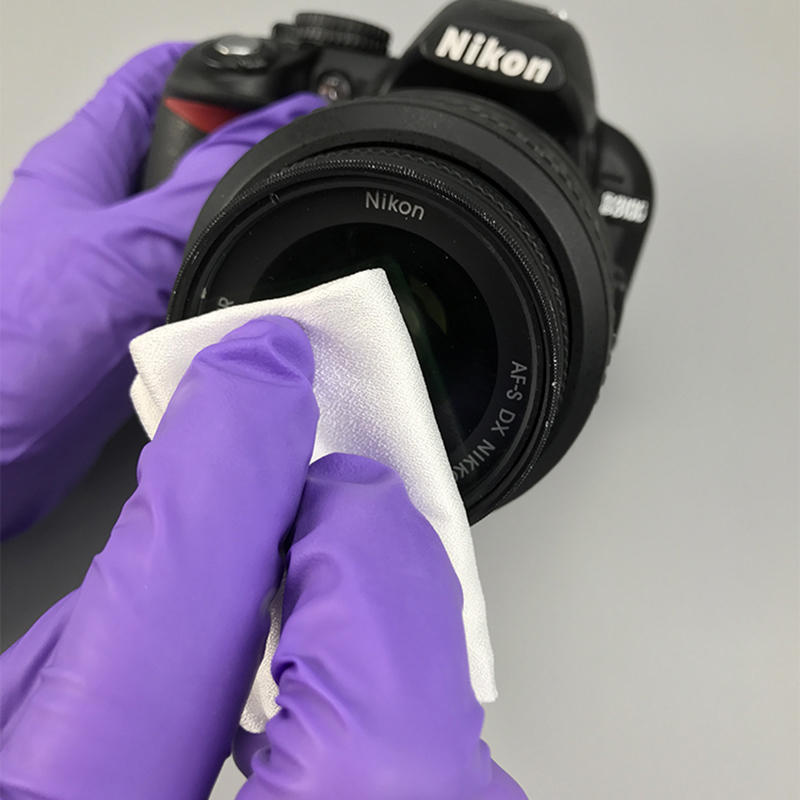 Custom JW-08522 Microfiber Wiper Suppliers, OEM/ODM Factory - Suzhou Jujie ElectSuzhou Jujie Electron Co.,Ltd is a China OEM/ODM JW-08522 Microfiber Wiper supplier and JW-08522 Microfiber Wiper factory, We specialize ...View Product →
When a Standard Polyester Cleanroom Wiper Still Makes Sense
Not every task needs microfiber. For routine wipe-downs of work surfaces, equipment housings, and fixtures in ISO Class 6–8 areas, a standard knit polyester wiper delivers reliable cleanliness at a lower cost per wipe.
- Wider solvent compatibility: polyester withstands acetone, isopropyl alcohol, and most aggressive process solvents. Microfiber blends containing polyamide can degrade in strong acids and certain bases.
- Predictable particle and ion data: established polyester wiper grades carry years of lot-verification data, making qualification faster.
- Lower unit cost: for high-volume wiping, polyester knit wipers typically cost a fraction of microfiber equivalents.
- Durability: polyester knit wipers resist tearing and linting during heavy wiping, and can be reused after validated laundering.
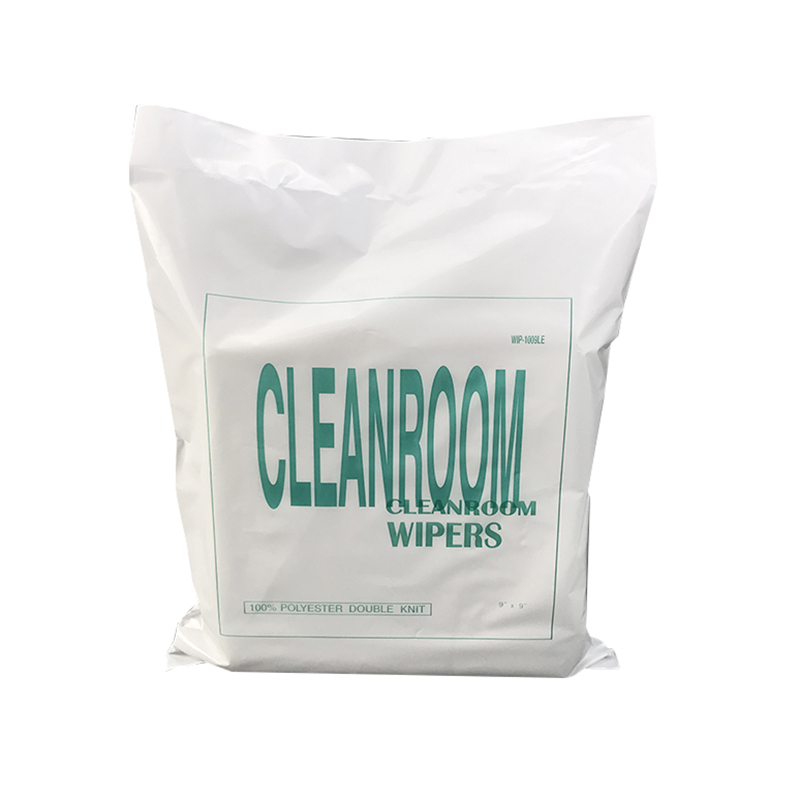
For general surface cleaning, many facilities standardise on a 1009LE cleanroom wiper, then reserve microfiber for critical final wipes.
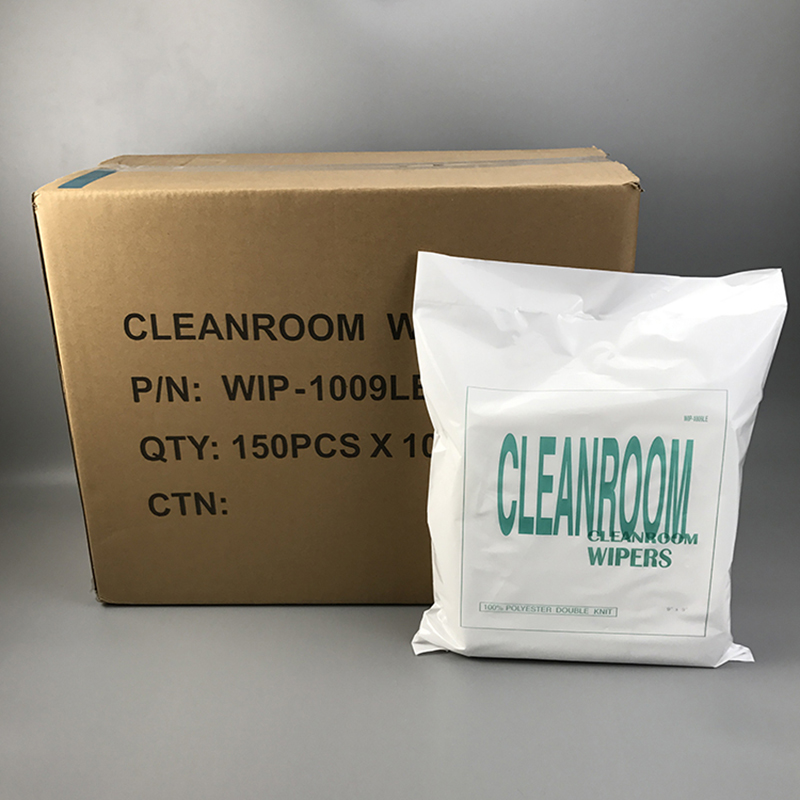 Custom 1009LE Cleanroom Wiper Suppliers, OEM/ODM Factory - Suzhou Jujie ElectronSuzhou Jujie Electron Co.,Ltd is a China OEM/ODM 1009LE Cleanroom Wiper supplier and 1009LE Cleanroom Wiper factory, We specialize in cus...View Product →
Don't Overlook ESD and Edge Treatment
In electronics assembly, semiconductor, and 5G-related manufacturing, static discharge is as dangerous as particles. A regular microfiber cloth can generate a triboelectric charge while wiping, and that charge can damage sensitive components. This is an area where cleanroom wipers diverge sharply from consumer cloths.
An ESD cleanroom wiper incorporates conductive carbon filaments that dissipate static charge safely. Pair it with an overview of antistatic dust-free cloth to see how conductive materials are qualified. Edge treatment matters just as much: laser-cut and ultrasonic-sealed edges keep the wipe from releasing fibres at the cut line, which is the single most common source of particle failure in cheap cloths.
 Custom ESD Wiper Suppliers, OEM/ODM Factory - Suzhou Jujie Electron Co.,LtdSuzhou Jujie Electron Co.,Ltd is a China OEM/ODM ESD Wiper supplier and ESD Wiper factory, We specialize in custom ESD Wiper and other pr...View Product →
For a deeper look at how ESD wipers behave in production cleaning, read our note on the main functions and advantages of ESD wipers.
How to Choose: A Practical Selection Guide
Use the following steps to shortlist the right wiper for your process.
- Confirm the ISO class of the area where the wipe will be used.
- Identify the contamination type: particles, chemical residue, biological matter, or a combination.
- Check surface sensitivity: optics and sensors demand microfiber; metal housings accept polyester.
- Verify chemical compatibility with your cleaning solution before buying in volume.
- Assess ESD risk in the surrounding process.
- Calculate cost per cleaning cycle, not just cost per wipe, including re-cleaning and yield loss.
| Application | Recommended Wiper | Reason |
|---|---|---|
| Final optics / sensor wipe | Cleanroom microfiber wiper | Sub-micron particle capture, low abrasion |
| Workbench and equipment wipe-down | Polyester knit cleanroom wiper | Low particle shedding, chemical resistance, lower cost |
| ESD-sensitive component zones | ESD cleanroom wiper | Dissipates static charge |
| Spill and residue pickup | Microfiber or high-absorbency wiper | Highest absorption rate |
Common Procurement Mistakes to Avoid
- Using consumer microfiber cloths in ISO Class 5 or cleaner areas — unsealed edges and high extractables will add particles and ions to your process.
- Ignoring edge sealing — an unsealed cut edge sheds fibres at the point of maximum friction.
- Overlooking ionic cleanliness — high chloride and sodium levels can cause corrosion on printed circuit boards and metal surfaces.
- Not checking packaging class — a "cleanroom wiper" packaged outside a cleanroom can arrive contaminated regardless of its fabric data.
- Buying on price per piece alone — rework, yield loss, and failed audits cost far more than the difference between a commercial cloth and a certified wiper.
Frequently Asked Questions
Can I use a regular microfiber cloth in a cleanroom?
Not for critical cleaning. Consumer microfiber cloths are not laundered in DI water, their edges shed fibres, and their ionic residues are uncontrolled. They may be acceptable for non-critical areas such as offices, but they do not meet cleanroom wipe specifications.
What is the difference between a cleanroom wiper and a cleanroom microfiber wiper?
A cleanroom wiper is usually 100% polyester knit or nonwoven, sealed and verified for particles and ions. A cleanroom microfiber wiper uses split polyester/polyamide filaments below one denier, which capture sub-micron particles more effectively and absorb liquid faster. Both are cleanroom-grade; microfiber simply adds a finer capture mechanism.
Can cleanroom wipers be reused?
Some polyester knit wipers are designed for validated laundering and reuse, provided the laundering process is certified and the wiper is re-tested. Microfiber wipers are more often single-use in critical processes because laundering can degrade the split filaments over time.
What does IEST-RP-CC004 cover?
IEST-RP-CC004 is the standard practice for evaluating wipers used in controlled environments. It defines test methods for particle counts, fibre counts, non-volatile residue, and ionic contamination, giving buyers a common basis for comparing wipers across suppliers.
Final Recommendation
The choice between a cleanroom wiper and a microfiber cloth is not either-or across your whole facility. Use certified polyester wipers for general surface cleaning, sealed-edge microfiber wipers for final critical wipes, and ESD wipers anywhere static-sensitive components are handled. Verify the spec sheet, the edge seal, and the packaging class for every product you qualify. If you need support selecting the right wiper for your ISO class and application, contact our cleanroom wiper team — we can help you match the product to the process rather than the other way around.