

 中文简体
中文简体 Español
 русский
 Deutsch
 Français
Content
- 1 Start with Cleanliness Data, Not Price
- 2 Compare the Main Material Families
- 3 Match the Wiper to the ISO Class and the Process Zone
- 4 Edge Sealing: A Small Detail with a Big Effect
- 5 Add ESD Control Where Static Is a Risk
- 6 Verify the Supplier Before You Commit
- 7 Frequently Asked Questions
- 8 Making the Final Decision
A process engineer in a 200 mm wafer fab once traced a sudden drop in die yield to a roll of hydroentangled nonwoven wipes used on a lithography track. The wipes looked clean and felt soft, but the liquid particle count exposed the problem. In semiconductor production, a cleanroom wiper is not a commodity supply item; it is a process consumable that directly controls particle, ionic, and organic contamination on the surfaces that touch the wafer.
The short answer to the selection question is this: match the wiper material to your cleanroom ISO class, the process step, and the cleaning chemistry, then verify every incoming lot with particle and extractable data. Do not choose by brand, color, or price per pack alone.
Start with Cleanliness Data, Not Price
Semiconductor geometries now reach into the low nanometer range, and a single particle larger than the critical defect size can destroy a die. Ordinary shop towels or industrial wipers are not acceptable near wafers because they shed fibers, release ionic residues, and leave non-volatile residue after the solvent evaporates.
Four metrics define a semiconductor-grade wiper:
- APC (airborne particle count): particles 0.5 µm and larger, and 5.0 µm and larger, released into air, usually reported per square meter. Lower is better.
- LPC (liquid particle count): particles released into deionized water or IPA, reported per milliliter. This is the most direct predictor of contamination during solvent wiping.
- Ionic extractables: chloride, sodium, potassium, sulfate, and other ions in ppm. These ions can cause corrosion and threshold voltage shifts in devices.
- NVR (non-volatile residue): residue left after solvent evaporation, reported in mg per gram of wiper. High NVR leaves a haze on optics and wafers.
The chart below shows typical relative airborne particle levels for common wiper material families. The values are illustrative for comparison; always request the actual test report from your supplier.
Nonwoven wipers release an order of magnitude more particles than knit polyester; keep them away from wafer-adjacent steps.
Compare the Main Material Families
Woven, knit, and nonwoven wipers all appear in cleanroom catalogs, but knit construction is the standard for critical semiconductor cleaning. A continuous filament polyester knit releases far fewer particles than woven or hydroentangled structures, and it resists the solvents and acids used in wafer processing.
| Material family | Typical construction | Best suited for | Main limitation |
|---|---|---|---|
| 100% polyester knit | Continuous filament knit, sealed edges | Wafer-adjacent cleaning, ISO Class 4-6 | Lower absorbency than microfiber |
| Sub-microfiber polyester | Fine-denier knit | Thin-film residue and oily soils | Verify compatibility with aggressive solvents |
| Microfiber 80/20 | Polyester/nylon split microfiber | Tool surfaces and general fab cleaning | Nylon can leave residues if quality is poor |
| ESD knit polyester | Polyester with conductive fiber | Static-sensitive process steps | Slightly higher particle level than plain knit |
| Hydroentangled nonwoven | Cellulose and polyester blend | Maintenance, sub-fab, non-wafer areas | High particle generation; keep out of wafer zones |
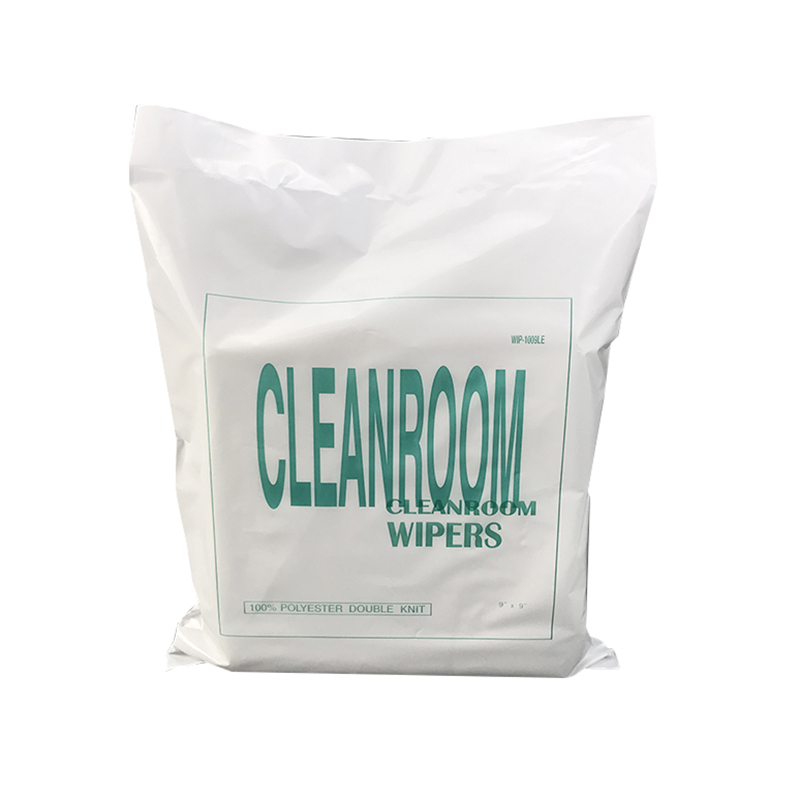
For wafer-facing applications, a 100% polyester knit sealed-edge wiper is the safest starting point. A product such as the 1009LE cleanroom wiper gives you a controlled baseline; our wiper production runs in ISO Class 5 and Class 6 cleanrooms, and the technical team can supply particle and extractable reports for qualification.
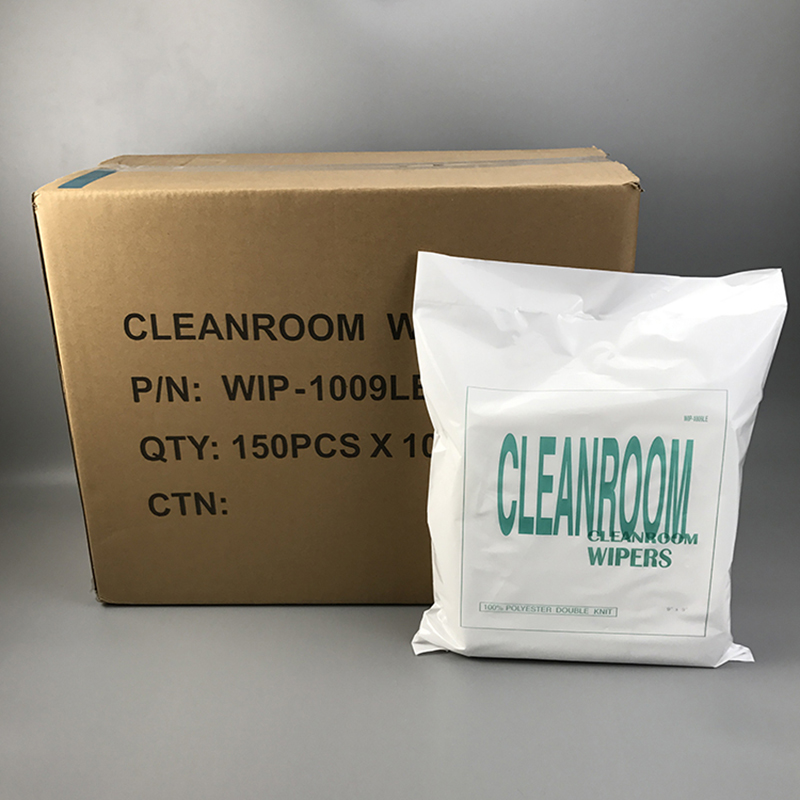 Custom 1009LE Cleanroom Wiper Suppliers, OEM/ODM Factory - Suzhou Jujie ElectronSuzhou Jujie Electron Co.,Ltd is a China OEM/ODM 1009LE Cleanroom Wiper supplier and 1009LE Cleanroom Wiper factory, We specialize in cus...View Product →
Match the Wiper to the ISO Class and the Process Zone
The same fab can use three different wipers in three different zones. The rule is simple: the wiper must be cleaner than the environment it is used in, because wiping can redeposit particles onto the surface.
- ISO Class 4-5 (lithography, etch, deposition): use 100% polyester knit with sealed edges and documented LPC at 0.5 µm and above. Never use nonwoven wipers in these zones.
- ISO Class 6 (track, metrology, EFEM, load ports): polyester knit or ESD knit, depending on the static sensitivity of the step.
- ISO Class 7-8 (equipment maintenance, sub-fab, gowning areas): microfiber or woven wipers control cost while still providing reliable cleaning.
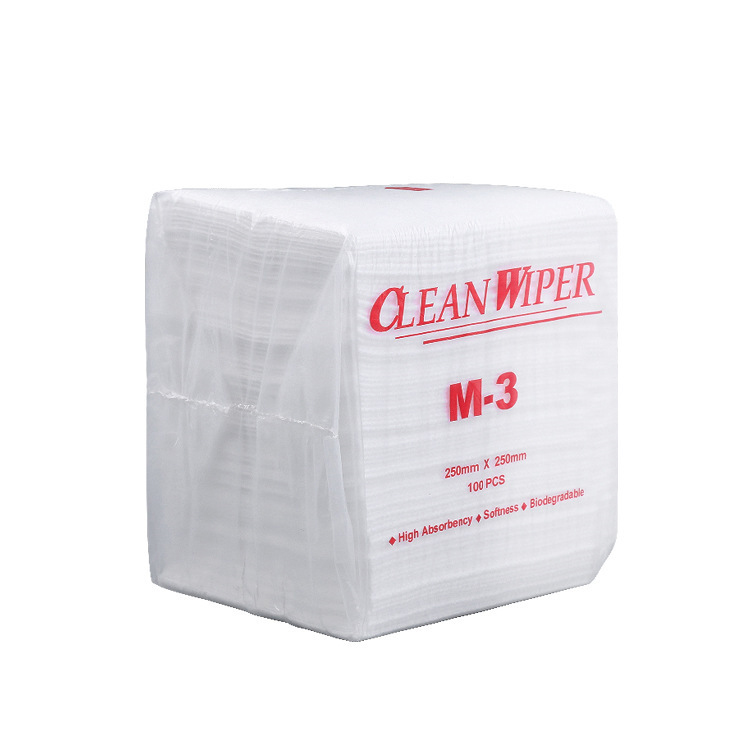
When the job is removing organic residue from tool exteriors in ISO Class 7 areas, the JW08522 microfiber wiper absorbs noticeably more liquid by weight than a standard knit, which shortens cleaning time and reduces chemical consumption.
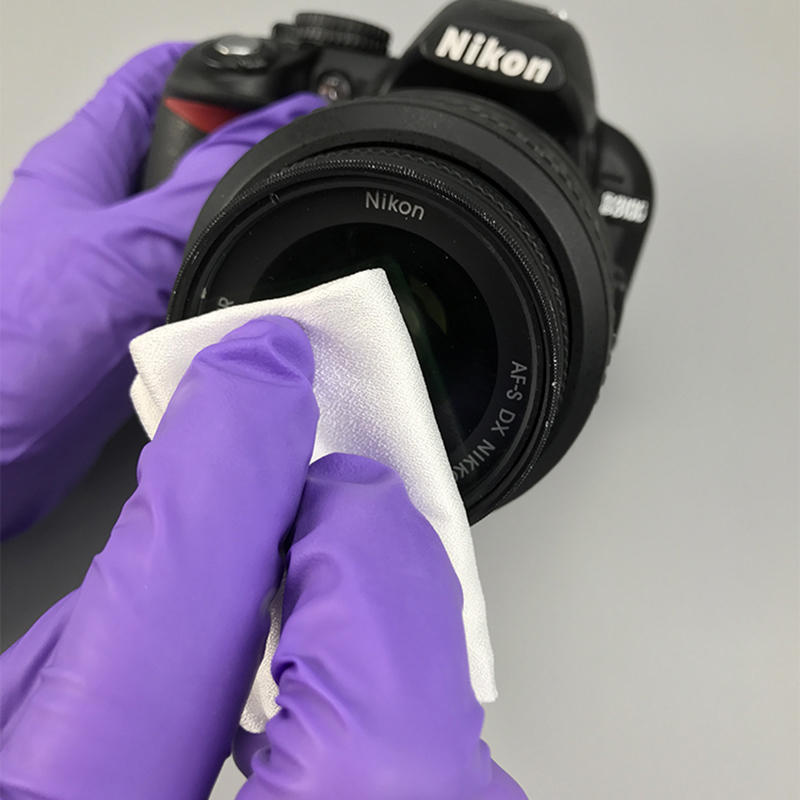 Custom JW-08522 Microfiber Wiper Suppliers, OEM/ODM Factory - Suzhou Jujie ElectSuzhou Jujie Electron Co.,Ltd is a China OEM/ODM JW-08522 Microfiber Wiper supplier and JW-08522 Microfiber Wiper factory, We specialize ...View Product →
The line chart below illustrates why technique and edge quality matter. A well-sealed knit wiper reaches a low steady state after a few strokes; a cut-edge wiper keeps shedding at a higher level for much longer.
The first strokes always release the most particles; a sealed edge lowers both the peak and the steady-state level.
Edge Sealing: A Small Detail with a Big Effect
Cut edges are the primary source of loose fibers in a cleanroom wiper. When a blade slices through a knit fabric, it opens the loops and leaves filament ends that can detach during wiping. Sealing the edge with heat, ultrasonic welding, or laser melting traps those filaments and keeps them out of the process.
- Use laser or ultrasonic sealed edges for ISO Class 5 and cleaner applications.
- Check that the sealed edge stays flexible; a stiff edge can scratch optics and polished surfaces.
- Inspect the edge under magnification during qualification and request edge particle data.
For more detail on why particle release happens even with a good wiper, see our analysis of why a cleanroom wiper releases particles during wiping.
Add ESD Control Where Static Is a Risk
A wiper can build up static charge as it slides across a surface. In a wafer fab, that charge can damage gate oxides or attract airborne particles to the very area you are cleaning. ESD wipers are knitted with a small percentage of conductive fiber, typically carbon-loaded polyester, that drains charge to ground when the operator is grounded through a wrist strap and mat.
Use an ESD wiper in wafer transfer areas, load ports, reticle handling, metrology tools, and anywhere a sensitive device sits unsupported.
When you qualify wipers for these zones, include an ESD grade in the trial. The ESD cleanroom wiper from the same series can be compared side by side with a standard knit for particle and charge decay performance.
 Custom ESD Wiper Suppliers, OEM/ODM Factory - Suzhou Jujie Electron Co.,LtdSuzhou Jujie Electron Co.,Ltd is a China OEM/ODM ESD Wiper supplier and ESD Wiper factory, We specialize in custom ESD Wiper and other pr...View Product →
Verify the Supplier Before You Commit
A data sheet only tells you what the supplier measured, not what they control. Because the wiper touches the same surfaces that touch the wafer, lot-to-lot consistency is the real requirement. Use this checklist during supplier qualification:
- Cleanroom manufacturing: the wiper should be laundered, dried, sealed, and packaged in a cleanroom at least as clean as your own process area.
- Lot traceability: every lot should carry a lot number and a test report covering APC, LPC, ionic extractables, and NVR.
- Solvent compatibility: verify the wiper in IPA, acetone, and any mixed chemistry you use before approval.
- Packaging integrity: double-bagged cleanroom poly is the minimum; add gamma irradiation only if sterility is actually required.
- Change notification: ask the supplier to inform you of any change in raw material, detergent, cut method, or sealing process.
If you want to turn these steps into a formal wiper specification, contact our cleanroom consumables team with your ISO class, cleaning solvent, and process step, and we will help you match a wiper grade to the risk profile.
Frequently Asked Questions
Can I use the same wiper for lithography and sub-fab maintenance?
No. Keep wafer-facing wipers separate from maintenance wipers. Hydroentangled nonwoven wipers are fine for floors and equipment frames, but they must never be used in lithography, etch, or any area where wafers are exposed.
Is a higher price a sign of better cleanliness?
Not always. Price often reflects packaging and brand position. Judge a wiper by particle and extractable data, not by price; a mid-price sealed-edge polyester knit can outperform a premium product in your specific chemistry.
Do I need sterile wipers in a semiconductor cleanroom?
Sterility is not the main concern in wafer fabs; particle count is. Sterile wipers are primarily a pharmaceutical and medical device requirement. If you do choose sterile wipers, confirm the sterilization method does not degrade the knit structure or increase extractables.
How often should I re-qualify after a supplier change?
Re-qualify whenever the supplier changes raw material, construction, edge sealing, detergent, or packaging line. Even a change in rinse water quality can shift ionic extractables by a large margin. A documented re-qualification protects the process and creates an audit trail.
Making the Final Decision
The right cleanroom wiper for semiconductor production is the one that meets your process limits for particles, ions, and residue, matches the ISO class of the zone, resists your cleaning chemistry, and comes from a supplier who can prove lot-to-lot consistency. Choose sealed edges where fibers are a risk, and ESD construction where static is a risk. With the framework above, wiper buying becomes a controlled process decision rather than a routine purchase.