

 中文简体
中文简体 Español
 русский
 Deutsch
 Français
Content
- 1 Quick Comparison: Disposable vs Washable Cleanroom Apparel
- 2 What Disposable Cleanroom Apparel Is Built For
- 3 What Washable Cleanroom Apparel Is Built For
- 4 Washable Cleanroom Apparel Product Range
- 5 How to Decide Between the Two
- 6 Supporting Consumables in Either System
- 7 Maintaining Washable Apparel Performance
The core difference is durability and how contamination control is maintained over time. Disposable cleanroom apparel is worn once and discarded, made from lightweight nonwoven fabric that keeps particle shedding low without any laundering step. Washable cleanroom apparel is a woven, carbon-fiber-blended garment engineered to be laundered and re-worn dozens or hundreds of times while keeping its antistatic and low-linting properties stable. Neither option is universally "better" — the right choice depends on cleanroom class, contamination risk, garment turnover rate, and total cost over the life of the garment.
Quick Comparison: Disposable vs Washable Cleanroom Apparel
Before going deeper, here is how the two categories stack up across the factors that matter most in a gowning program.
| Factor | Disposable Apparel | Washable Apparel |
| Base Material | SMS or PP nonwoven fabric | Woven polyester with conductive carbon fiber grid |
| Typical Lifespan | Single use, then discarded | 50 to 100+ industrial wash cycles |
| Charge Decay After Aging | Not applicable, replaced before performance drops | Stays at or below 1 second after 50+ washes |
| Surface Resistivity | Varies by fabric grade, generally low ESD spec | 10⁷ to 10⁹ Ω, aligned with GB 12014-2019 |
| Cleanroom Class Fit | ISO 5 to ISO 8, contamination or biohazard tasks | ISO 5 to ISO 7, long-shift semiconductor and precision work |
| Upfront Cost | Low per unit, recurring purchase | Higher per garment, one-time plus laundering |
| Waste Generated | High, continuous nonwoven waste stream | Low, garment reused until end of service life |
What Disposable Cleanroom Apparel Is Built For
Disposable garments — coveralls, sleeves, and single-use gowns — are made from spunbond-meltblown-spunbond (SMS) or polypropylene nonwoven fabric. The material is engineered once, worn once, and removed without ever entering a laundering cycle, which eliminates the risk of cross-batch contamination between users or shifts. This makes disposables the default choice for:
- Short visitor or contractor entries where fit and reuse tracking are impractical
- Biological or chemical contamination zones where a garment cannot be safely re-laundered
- High turnover cleanrooms where hundreds of gowning cycles happen daily
- Facilities that want to avoid the water, energy, and chemical load of industrial laundering
Disposable apparel is almost always paired with other single-use consumables such as a Cleanroom Face Mask and a Cleanroom Shoe Cover, since the entire gowning kit is discarded together at the end of a session.
What Washable Cleanroom Apparel Is Built For
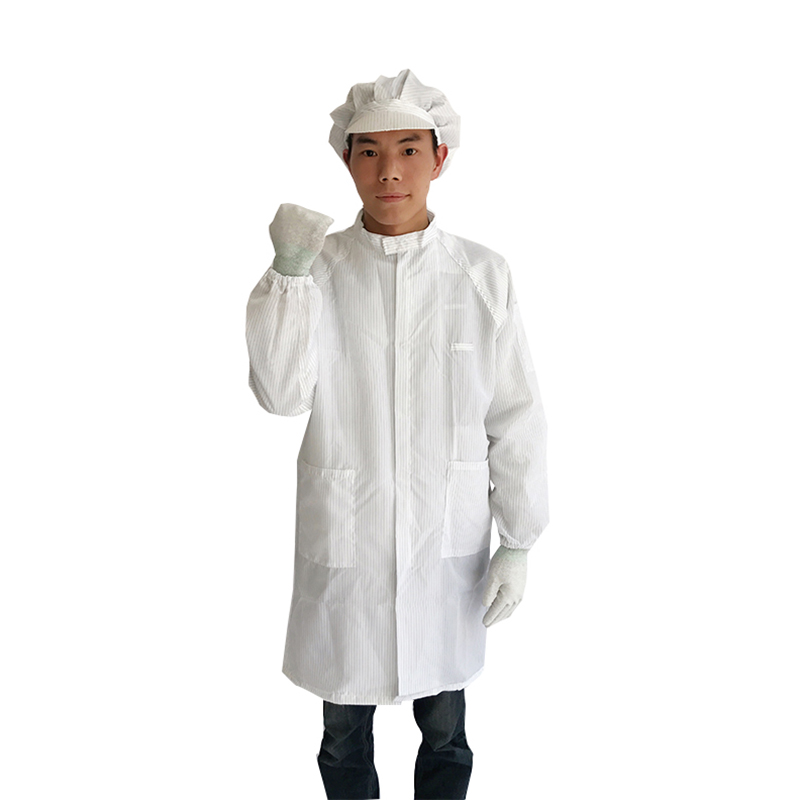
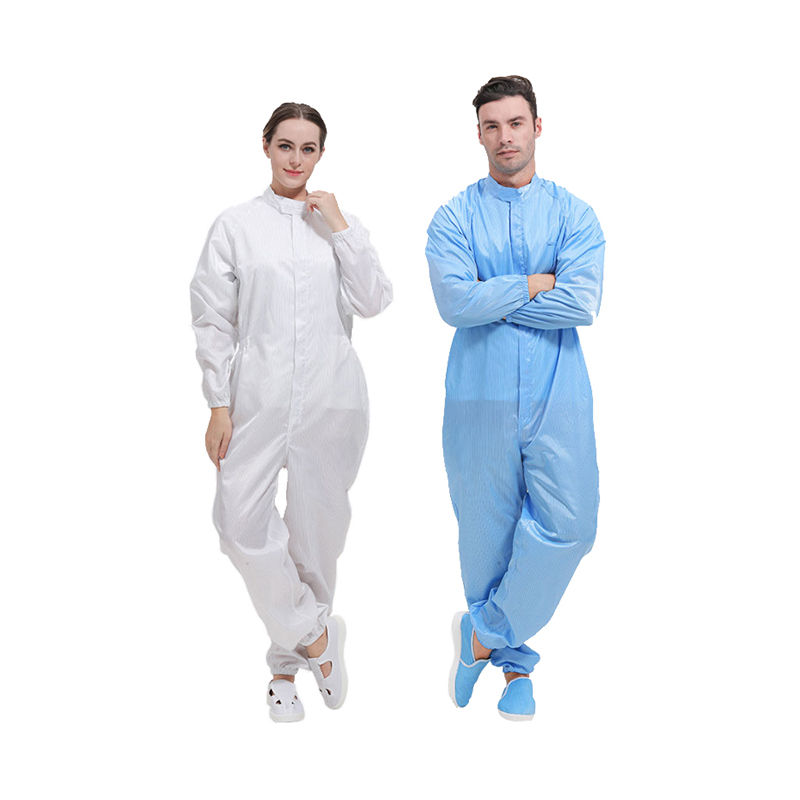
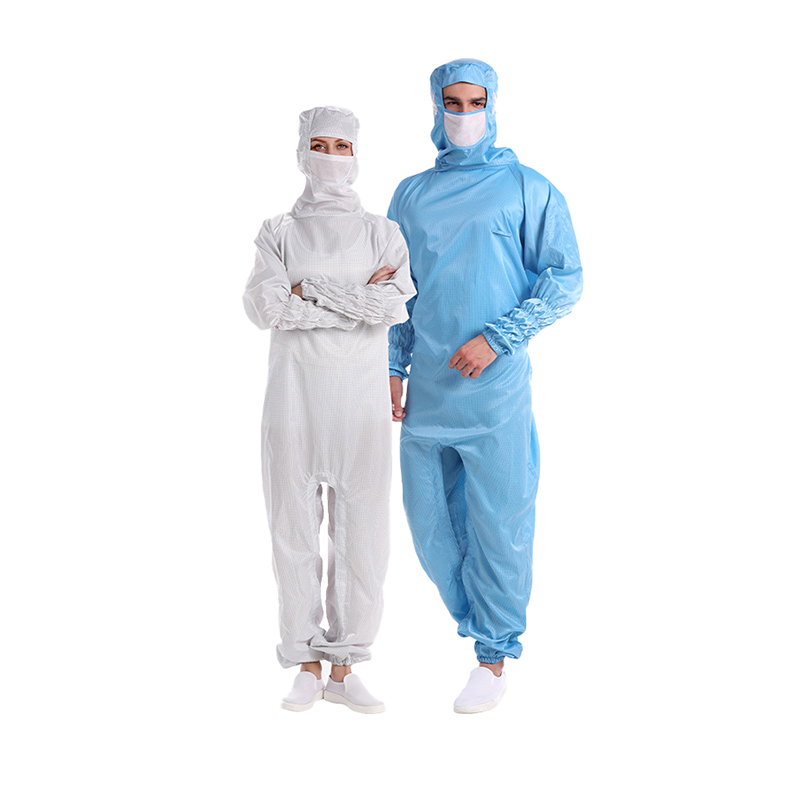
Washable, or reusable, cleanroom apparel uses a woven polyester base with a conductive carbon fiber grid, sometimes called ESD or antistatic clothing. Because the fabric is a tighter, engineered weave rather than a bonded nonwoven, it survives repeated industrial laundering without losing its static-dissipative structure. In production data, Antistatic Clothing built this way keeps a charge decay time of 1 second or less even after more than 50 wash cycles, with surface resistivity held between 10⁷ and 10⁹ Ω under GB 12014-2019.
Reusable garments are the standard for:
- Semiconductor and electronics lines where static discharge risk to components must stay consistent shift after shift
- Pharmaceutical and bioengineering cleanrooms operating under GMP, where breathable, long-wear fabric supports extended shifts
- Photovoltaic and new energy production, where conductive fiber quickly dissipates body-generated static around fragile cells
- Precision machinery and aerospace assembly, where wear-resistant, antistatic fabric needs to survive repeated flexing and movement
Washable Cleanroom Apparel Product Range
The garments below are woven, carbon-fiber-blended styles designed for repeated industrial laundering while holding stable antistatic performance across the wash cycles listed above.


How to Decide Between the Two
Four questions usually settle the decision for a given cleanroom zone.
How often is the garment worn per week?
High-frequency, same-operator use favors washable apparel since the per-wear cost drops quickly after the first dozen cycles.
Is static discharge control critical to the product?
Semiconductor and electronics lines typically standardize on Antistatic Clothing paired with Antistatic Shoes, an Antistatic Cap, and Antistatic Gloves because these items keep their conductive properties across many shifts.
Does the process involve biological or chemical hazards?
Disposable garments remove the risk of carrying contamination between wash loads, which is why they dominate biosafety and hazardous handling zones.
Can the facility support a laundering program?
Washable apparel needs a validated, controlled laundering process to keep particle release low; without it, reusable garments can underperform disposables.
Supporting Consumables in Either System
Apparel choice rarely stands alone — it works alongside the rest of the gowning and floor-control kit. A well-run cleanroom typically combines apparel with a Cleanroom Wiper or Nonwoven Wipes for surface cleaning, a Clean Swab for detail work, and floor contamination control from a Sticky Mat or Sticky Roller at entry points. For electronics-adjacent tasks, an Antistatic Mat and Antistatic Tweezer round out static protection at the workstation level, regardless of whether the garment worn that day is disposable or washable.
Maintaining Washable Apparel Performance
Reusable garments only stay effective if laundering is controlled. Three practices keep charge decay and particle release within spec across the garment's life:
- Launder in a dedicated cleanroom-grade facility, separate from regular industrial textiles, to avoid lint transfer
- Track wash counts per garment so units are retired before conductive fiber performance drifts out of spec
- Test a sample batch periodically for surface resistivity and charge decay rather than relying on wash count alone
Facilities producing this apparel in an ISO Class 5/6 environment, with particle counts held at or below 100 particles per cubic foot for particles 0.5 micron and larger, are generally better positioned to guarantee that the garment performs the same on wash cycle 50 as it did on wash cycle 1.