

 中文简体
中文简体 Español
 русский
 Deutsch
 Français
When sourcing cleanroom wipers for controlled environments, the manufacturer you choose directly determines whether your ISO classification holds or fails. A qualified cleanroom wiper manufacturer must operate its own lint-free production facility — ideally certified to ISO Class 5 or Class 6 — and back every product with particle-release data, not just marketing claims. Suzhou Jujie Electron Co., Ltd. (JEJOR), founded in 2005, exemplifies this standard: its 33,000 m² campus includes 8,000 m² of NEBB-certified cleanrooms, 48 automated production lines, and laser cutting machines imported from Japan with a cutting accuracy of +/-0.01 mm.
What a Cleanroom Wiper Actually Does
A cleanroom wiper is not simply a cloth that looks clean. Its job is to physically capture and retain particles, solvents, and residues without releasing fibers or generating static charge during the process. Three mechanisms make this possible:
The microporous structure between fibers traps dust and particles rather than smearing them. High-density microfiber wipers — such as the JW-08522 and JW-09012 — capture more than 99% of particles larger than 0.1 micrometers, leaving virtually no residue on wiped surfaces.
Every production step — weaving, washing, shaping, and cutting — is conducted inside an ISO Class 5/6 cleanroom. The JW-24011 two-ply polyester wiper uses a lint-free finishing process that densifies surface fibers, making particle shedding during use negligible.
ESD wipers such as the JW-14061 integrate conductive fibers that dissipate static electricity at the source, breaking the cycle in which static charge attracts airborne particles onto freshly cleaned surfaces — a critical concern on semiconductor assembly lines.
Core Product Types and Their Applications
A capable cleanroom wiper manufacturer covers multiple substrate types because different ISO grades, industries, and cleaning tasks demand different materials. The table below maps JEJOR's main product families to their primary use contexts.
| Product Type | Key Models | Primary Application | Notable Feature |
|---|---|---|---|
| ESD Wiper | JW-14061, JW-18043 | Semiconductor, PCB assembly | Conductive fibers dissipate static below 100 V |
| Microfiber Wiper | JW-08522, JW-09012, JW-10012, JW-18033 | Optics, medical devices, precision instruments | Captures particles larger than 0.1 micrometers at 99%+ efficiency |
| Submicrofiber Wiper | Submicrofiber series | High-end semiconductor, pharmaceutical | Fiber refinement technology improves 0.3 micrometer capture by 15% |
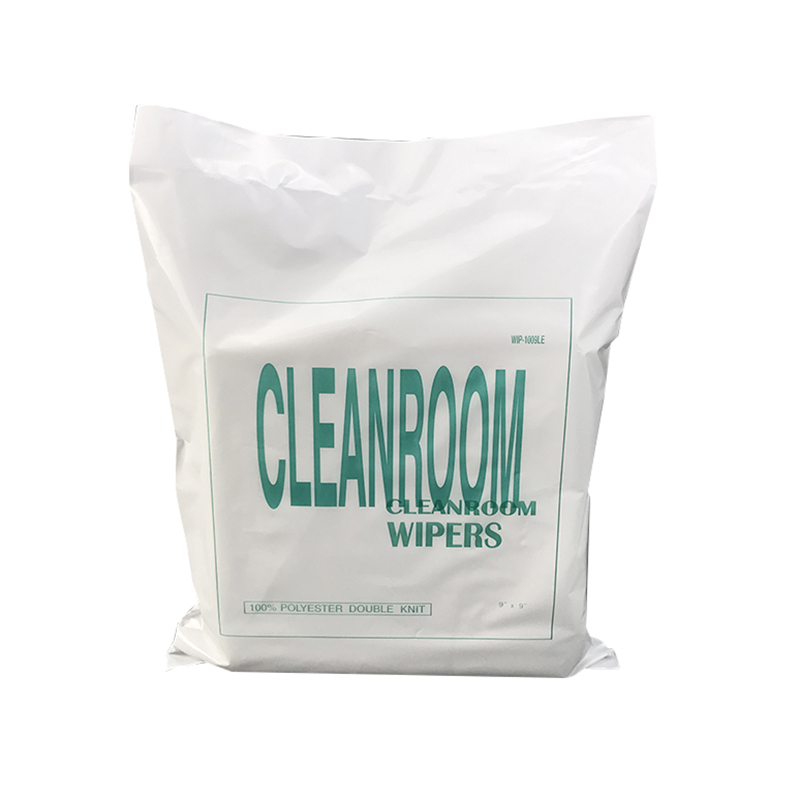
| Polyester Cleanroom Wiper | JW-24011 (2-ply), 1009LE, Black series | ISO Class 5-7 cleanrooms, wall/floor maintenance | Low ionic contamination, wet/dry compatible |
| LCD Roll Wiper | LCD Roll series | LCD/OLED display manufacturing | Anti-scratch soft face plus anti-static coating |
Industry-Specific Use Cases
Semiconductor Wafer Processing
Wafer surfaces must achieve submicron cleanliness before every lithography step. The JW-18043 microfiber wiper's fine fiber architecture precisely removes photoresist residue and metallic particles without scratching the substrate, helping protect chip yield from contamination-induced defects.
LCD and OLED Display Production
Display glass is simultaneously fragile and statically sensitive. The LCD roll wiper combines a soft microfiber face with an anti-static coating, cleaning the display layer without micro-scratching and preventing static-driven dust re-deposition in the same stroke.
Electronic Equipment Maintenance
Server boards, routing hardware, and cooling systems accumulate fine conductive dust that threatens both thermal performance and signal integrity. The JW-10012 microfiber wiper's wet-dry dual-use design removes dust without leaving water marks, restoring stable heat dissipation.
Cleanroom Environment Maintenance
Maintaining ISO Class 5 air quality over extended production cycles requires regular wiping of walls, floors, and equipment casings. The 1009LE cleanroom wiper delivers sustained low particle release to prevent incremental contamination buildup that degrades the cleanroom classification over time.
How Manufacturer Quality is Built Into the Process
Evaluating a cleanroom wiper manufacturer means looking past the product datasheet and examining the production system that generates it. Three layers matter most.
Production Environment
JEJOR's manufacturing operates inside 8,000 m² of NEBB-certified lint-free cleanrooms built to ISO Class 5 and Class 6 standards — significantly cleaner than conventional manufacturing environments. Constant temperature and humidity control throughout the JW-24011 polyester wiper line eliminates environmental contamination as a quality variable.
Automated Equipment
48 automated production lines handle weaving, washing, and shaping in an integrated sequence. Japanese laser cutters achieve an edge accuracy of +/-0.01 mm; German infrared spectrometers verify fiber purity at the material stage; South Korean and U.S.-sourced liquid particle counters monitor wash water cleanliness in real time. This combination drives 99.9% product consistency across batches.
Three-Stage Testing
Raw materials undergo infrared spectrometer fiber purity verification. In-process wash water is tested by liquid particle counter. Finished wipers pass particle release testing, water absorption testing, and anti-static performance testing before leaving the facility. This end-to-end validation chain means failures are caught at origin rather than at the customer's production line.
Key Criteria When Selecting a Cleanroom Wiper Manufacturer
Not every supplier that sells cleanroom wipers manufactures them under controlled conditions. The following checklist distinguishes a qualified manufacturer from a trading company repackaging generic stock.
- Owned cleanroom production facility The manufacturer should produce inside certified cleanrooms — ISO Class 5 or 6 minimum — not outsource to unverified third parties.
- Independent particle release data Request particle count reports from a liquid particle counter, not just a general quality certificate. Specific numbers — particles per wiper per milliliter — are the standard.
- ISO grade range coverage A full-range manufacturer offers products validated for ISO Class 4 through 8, allowing you to scale or adjust cleanliness specifications without switching suppliers.
- Material traceability Fiber purity should be verifiable by infrared spectrometry. Undocumented blends introduce ionic contamination risk, especially for semiconductor and pharmaceutical applications.
- OEM/ODM capability Custom sizes, anti-static treatments, or specific packaging requirements indicate real manufacturing infrastructure rather than catalog reselling.
- Third-party certifications NEBB certification, ISO facility certification, and documented test reports provide independent verification beyond the manufacturer's own claims.
Why Material Choice Changes Everything
Two buyers can purchase a "cleanroom wiper" and receive fundamentally different products depending on fiber type. The material determines particle capture efficiency, compatibility with cleaning solvents, and whether the wiper is safe near ESD-sensitive components.
Polyester Wipers
100% polyester construction delivers low ionic contamination and strong chemical resistance. Suitable for ISO Class 5-7 environments. The 1009LE and JW-24011 two-ply variants are the standard choice for general cleanroom maintenance, equipment casing cleaning, and solvent wiping where fiber shedding must be controlled but ultra-fine particle capture is not the primary requirement.
Microfiber and Submicrofiber Wipers
Polyester-nylon blended microfiber achieves higher particle capture through increased fiber density and smaller fiber diameter. Submicrofiber variants — using fiber refinement and surface modification technology — raise capture efficiency for 0.3-micrometer particles by approximately 15% compared to standard microfiber. These are the correct choice for semiconductor photolithography, optical surface preparation, and pharmaceutical filling-line cleaning where contamination tolerances are measured in parts per trillion.
ESD Wipers
Conductive fibers woven into the microfiber substrate create a path for static dissipation during the wiping motion. On a semiconductor line where a single electrostatic discharge event can destroy a component worth hundreds of dollars, this design eliminates both the particle risk and the charge risk simultaneously. Models JW-14061 and JW-18043 are built for this combined-protection application.
The Bottom Line for Procurement Teams
A cleanroom wiper manufacturer worth qualifying will be transparent about three things: the ISO grade of their production environment, the particle release data for each product, and the testing equipment used to generate that data. These three data points separate manufacturers with genuine contamination control infrastructure from suppliers that simply resell products made elsewhere. For industries where a single contaminated wiper can cost far more than a full order of premium wipers — semiconductors, medical devices, aerospace components — the sourcing decision is a risk management decision, not just a cost decision. Verify the production standard first, then evaluate the product range against your specific ISO classification and cleaning application.