

 中文简体
中文简体 Español
 русский
 Deutsch
 Français
Content
- 1 Anti-Static Shoe Covers vs. Disposable Shoe Covers: Fundamental Differences in Functional Positioning
- 2 Cleanroom Shoe Cover Quality Control System: Triple Assurance from Raw Materials to Finished Products
- 3 Cleanroom Shoe Cover Product Matrix: Three Core Categories Covering Diverse Needs
- 4 Selection Guide: How to Match Compliant Cleanroom Shoe Covers to Your Application Environment
- 5 Industry Trends: Intelligence and Sustainability Reshaping the Future of Cleanroom Shoe Covers
Cleanroom shoe covers are not merely dust-prevention tools but a critical component of the electrostatic discharge (ESD) protection system in modern precision manufacturing. In ISO Class 5 and higher cleanroom environments, human body model (HBM) electrostatic discharge can reach 1,000V to 3,000V, sufficient to break down the gate oxide layers of semiconductor devices. Professional anti-static shoe covers utilize conductive fiber composite materials to continuously dissipate human static electricity to the ground, with surface resistance controlled within the 10⁶ to 10⁹ ohm range, reducing electrostatic potential to below 100V and thereby preventing latent damage to microcircuits.
Meanwhile, disposable shoe covers serve a fundamental physical isolation function in medical, food processing, and other scenarios, preventing particulate matter and microorganisms carried on shoe soles from contaminating controlled environments. Although the two product types may appear similar, they differ fundamentally in material science, conductive mechanisms, and applicable standards. Incorrect selection can lead to entire production batch scrappage or healthcare-associated infection incidents.
Anti-Static Shoe Covers vs. Disposable Shoe Covers: Fundamental Differences in Functional Positioning
Core Functions: Static Elimination vs. Physical Isolation
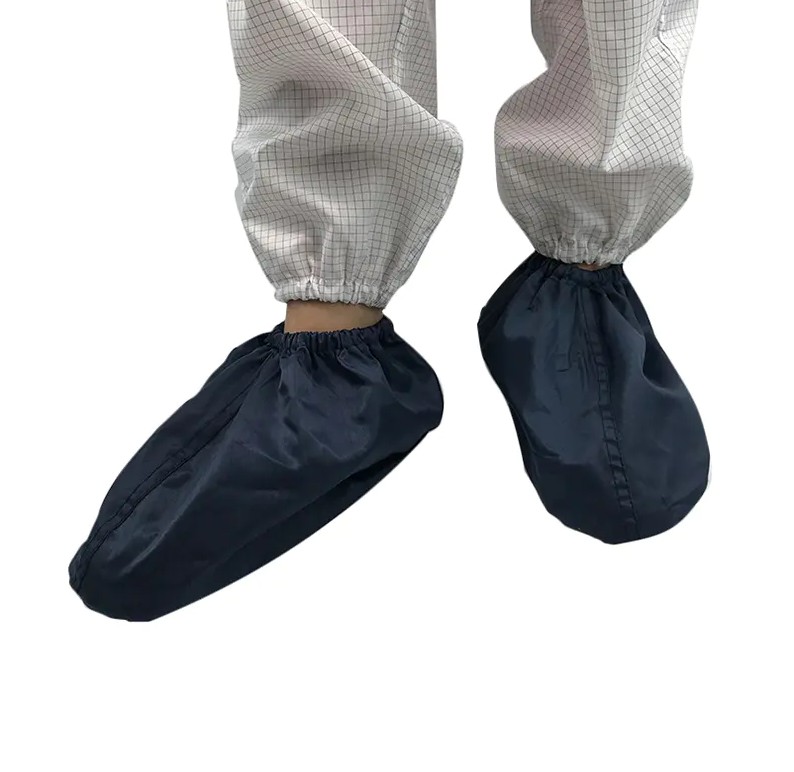
The primary mission of anti-static shoe covers is to establish a static dissipation channel between the human body and the earth. They employ a composite structure of conductive fibers and high-strength wear-resistant substrates, conducting static charges generated by walking friction to anti-static flooring in real time through conductive layers on the sole or upper. In wafer fabrication facilities, a single human electrostatic discharge event by an operator not wearing compliant anti-static shoe covers can cause chip losses valued at tens of thousands of dollars.
Disposable shoe covers focus on basic isolation protection, typically manufactured from polyethylene (PE) or non-woven fabric. They create a physical barrier to prevent dust, bacteria, and liquid contaminants on shoe soles from entering clean areas. They lack conductive properties, and their use in electrostatic protected areas (EPA) may actually accumulate static electricity due to the insulating nature of the materials, exacerbating discharge risks.
Application Scenarios: High-Precision Cleanrooms vs. General Protection Environments
Anti-static shoe covers are primarily deployed in the following electrostatic-sensitive industries:
- Semiconductor and integrated circuit manufacturing (ISO 14644-1 Class 5/6)
- Lithium battery production and assembly workshops
- Flat panel display and optoelectronic device manufacturing
- Aseptic pharmaceutical and bioengineering
Disposable shoe covers are widely used in hospital operating rooms, food processing plants, laboratories, and household settings, meeting short-term, high-frequency, low-cost consumption needs.
Materials and Durability: Specialized Conductive Materials vs. Low-Cost Isolation Materials
Anti-static shoe covers are made from conductive fiber composites with high-strength wear-resistant fabrics, combining electrostatic conductivity and mechanical durability, and can be reused more than 50 times. Their materials must simultaneously satisfy triple indicators of conductivity, low particle generation, and washability. Disposable shoe covers primarily use PE plastic or polypropylene non-woven fabric, featuring light weight and easy donning/doffing, but lack durability and are discarded after a single use.
Cleanroom Shoe Cover Quality Control System: Triple Assurance from Raw Materials to Finished Products
Hardware Investment: Automated Production Lines and Clean Manufacturing Environments
Leading cleanroom protective equipment manufacturers have established fully automated production systems. Taking typical industry enterprises as examples, their production facilities include 48 automated weaving, washing, and shaping production lines, increasing production capacity by 10 times compared to traditional models. Production workshops feature 8,000 square meters of dust-free workshops within an overall plant area of 33,000 square meters, with cleanliness reaching ISO Class 5/6 standards and NEBB certification, eliminating contamination risks during the production process from the source.
Key production equipment includes:
- Japan-imported laser cutting machines and ultrasonic cutting machines, achieving precision cutting and seamless sealing of shoe cover edges
- Germany, USA, and Korea-imported infrared spectrometers and liquid particle counters for raw material composition analysis and cleanliness testing
Standard Certifications: Dual Compliance with International Standards and Industry Regulations
Cleanroom shoe covers must simultaneously satisfy multiple international and industry standards:
| Standard Number | Standard Name | Core Indicators | Applicable Products |
|---|---|---|---|
| ISO 14644-1 | Cleanrooms and Associated Controlled Environments | Air Cleanliness Class (Class 5-8) | Anti-static / Disposable Shoe Covers |
| IEC 61340 | Electrostatics—Protection of Electronic Devices from Electrostatic Phenomena | Surface Resistance 10⁶-10⁹ Ω | Anti-static Shoe Covers |
| ISO 9001 | Quality Management System | Full-Process Quality Traceability | All Shoe Cover Categories |
| NEBB | Cleanroom Performance Certification | Cleanroom Construction and Operational Compliance | Anti-static Shoe Covers |
Full-Process Inspection: "Zero-Defect" Control from Raw Materials to Finished Products
Quality control spans three key stages:
- Raw Material Inspection: Component analysis and cleanliness testing on plastics, fibers, and other raw materials; non-compliant materials are prohibited from entering the production line
- In-Process Monitoring: Each production line is equipped with online inspection systems to monitor shoe cover dimensions, sealing strength, and electrostatic impedance parameters in real time, with immediate rejection of defective products
- Finished Product Verification: Sampling from each batch undergoes destructive testing (abrasion resistance, anti-static attenuation) and non-destructive testing (cleanliness, dimensional accuracy) to ensure delivery quality
Cleanroom Shoe Cover Product Matrix: Three Core Categories Covering Diverse Needs
Based on more than 15 years of cleanroom product research and development experience, the current market has formed three core product categories, corresponding to different usage cycles, protection levels, and cost structures.
Anti-Static Shoe Covers: The Static Guardian for High-Precision Cleanrooms
Designed specifically for ISO Class 5/6 clean environments including electronic chip manufacturing, semiconductor packaging, optoelectronic display, and aseptic pharmaceutical production. Made from conductive fiber composite wear-resistant fabrics with excellent electrostatic conductivity, abrasion and tear resistance, and can be reused more than 50 times. NEBB-certified to meet stringent cleanroom static control requirements, they have become the standard configuration for electronics industry customers.
Disposable Shoe Covers: A Convenient and Efficient Basic Protection Solution
Using PE plastic or non-woven fabric as the base material, featuring light weight and easy donning/doffing, with waterproof, dustproof, and antibacterial functions. Suitable for hospitals, laboratories, food factories, and household settings, meeting short-term, high-frequency, low-cost consumption needs. Ultrasonic cutting technology produces smooth, burr-free edges that resist tearing during donning and doffing, significantly improving user experience.
Reusable Shoe Covers: An Economical Choice for Long-Term Operations
Manufactured from washable, abrasion-resistant polyester or nylon, capable of withstanding more than 100 industrial washing cycles, achieving a balance between protection performance and economy. Suitable for laboratory researchers and factory workers who require frequent donning and doffing of shoe covers. Special treatment processes effectively prevent pilling and deformation, maintaining stable protective performance over long-term use.
| Comparison Dimension | Anti-Static Shoe Covers | Disposable Shoe Covers | Reusable Shoe Covers |
|---|---|---|---|
| Core Function | Static Dissipation | Physical Isolation | Physical Isolation |
| Primary Materials | Conductive Fiber Composite Fabric | PE / Non-woven Fabric | Polyester / Nylon |
| Usage Count | 50+ times | 1 time | 100+ times |
| Applicable Cleanliness Class | ISO Class 5/6 | ISO Class 7/8 | ISO Class 7/8 |
| Typical Application Scenarios | Semiconductor / Battery / Pharmaceutical | Hospital / Food / Laboratory | Factory / Laboratory Daily Use |
Selection Guide: How to Match Compliant Cleanroom Shoe Covers to Your Application Environment
Incorrect shoe cover selection not only wastes costs but may also trigger quality incidents. The following decision framework can help procurement and engineering personnel quickly identify suitable products:
Step 1: Identify Environmental Electrostatic Sensitivity
If the work area involves semiconductors, PCBs, precision sensors, or flammable and explosive substances, anti-static shoe covers must be selected, and their surface resistance must be verified to comply with the 10⁶ to 10⁹ ohm range specified in IEC 61340. For general medical or food protection, disposable shoe covers are sufficient.
Step 2: Confirm Cleanliness Class Requirements
ISO 14644-1 Class 5/6 environments (no more than 3,520 particles ≥0.5μm per cubic meter) require shoe covers with low particle generation properties, typically necessitating woven anti-static fabrics. Class 7/8 environments may use non-woven fabric or PE disposable products.
Step 3: Evaluate Usage Frequency and Cost Structure
For fixed positions with more than 10 donning/doffing cycles per day, reusable shoe covers typically offer lower comprehensive costs than disposable products over a 3 to 6 month cycle. For visitors or temporary personnel, disposable shoe covers offer advantages in convenience and hygiene management.
Step 4: Verify Supplier Qualifications and Testing Capabilities
Prioritize suppliers meeting the following conditions:
- ISO 9001 Quality Management System certification
- Independent clean production workshops with NEBB certification
- Key testing equipment including infrared spectrometers and surface resistance testers
- Ability to provide batch testing reports and traceability records
Industry Trends: Intelligence and Sustainability Reshaping the Future of Cleanroom Shoe Covers
As semiconductor process nodes advance to 3nm and below, and biopharmaceutical requirements for aseptic environments continue to escalate, the cleanroom shoe cover industry is facing two major technological transformations:
Intelligent Monitoring: From Passive Protection to Active Early Warning
Next-generation anti-static shoe covers are beginning to integrate micro-sensors capable of real-time monitoring of the wearer's electrostatic potential, grounding continuity, and shoe cover surface contamination levels. Data is transmitted wirelessly to central monitoring systems; upon detection of electrostatic exceedance or shoe cover damage, the system immediately triggers alarms and locks the relevant area, achieving the transition from "post-event detection" to "real-time prevention and control."
Sustainable Materials: Balancing Environmental Protection and Performance
In the context of global carbon reduction, biodegradable non-woven fabrics, recycled polyester fibers, and other eco-friendly materials are gradually replacing traditional PE plastics. Some leading manufacturers have launched green shoe cover products with carbon footprints reduced by more than 30%, meeting the ESG procurement standards of multinational corporations while maintaining ISO compliance.